Category: Retirement Planning

Plan your financial future with retirement savings strategies, pension planning, IRAs, 401(k)s, and wealth preservation.

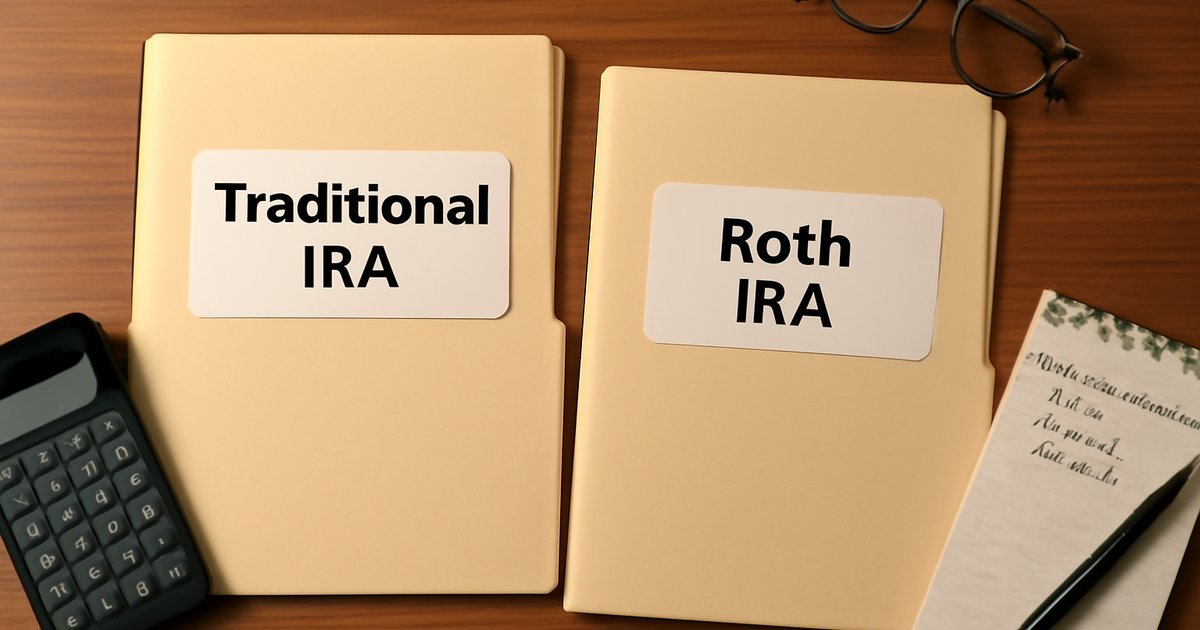
  • Traditional IRA vs Roth IRA: Which One Is Right for You

    Traditional IRA vs Roth IRA: Which One Is Right for You

    Two Accounts, One Big Decision

    Choosing the wrong IRA could cost you tens of thousands of dollars in retirement — here’s how to pick the right one.

    According to the Investment Company Institute, Americans held over $13.9 trillion in Individual Retirement Accounts as of 2024 — yet a surprising number of savers still aren’t sure which type of IRA they actually have, or whether it’s the best fit for their situation.

    If you’ve ever typed "Traditional IRA vs Roth IRA" into a search bar and walked away more confused than before, you’re not alone. Both accounts help you save for retirement. Both offer significant tax advantages. But the differences between them — especially around when you get taxed — can have a dramatic impact on how much money you actually keep in retirement.

    In this guide, you’ll learn exactly how each account works, who benefits most from each, how contribution limits and income rules apply in 2026, and the key mistakes people make when choosing between them. By the end, you’ll have a clear framework for making this decision with confidence.

    This article is for educational purposes only and does not constitute financial, tax, or investment advice. Always consult a licensed financial advisor, CPA, or attorney before making financial decisions.


    What Is a Traditional IRA and How Does It Work?

    A Traditional IRA (Individual Retirement Account) is a tax-advantaged savings account that lets you contribute pre-tax or after-tax dollars — and defer taxes on your investment growth until you withdraw the money in retirement.

    Here’s the core mechanic: if you qualify for a deductible contribution, the money you put in reduces your taxable income today. For example, if you earn $80,000 and contribute $7,000 to a Traditional IRA, your taxable income drops to $73,000 for that year. You pay taxes on the money — plus any growth — only when you take distributions later.

    According to the IRS, the 2026 contribution limit for both Traditional and Roth IRAs is $7,000 per year, with a $1,000 catch-up contribution allowed if you’re age 50 or older — bringing the maximum to $8,000.

    The deductibility of your Traditional IRA contributions depends on whether you (or your spouse) have access to a workplace retirement plan like a 401(k) and what your income is. If neither of you has a workplace plan, your contributions are fully deductible regardless of income.

    Once you reach age 73, you are required to take distributions — known as Required Minimum Distributions, or RMDs — whether you need the money or not. This is a key distinction that separates Traditional IRAs from Roth IRAs.

    What Is a Roth IRA and How Is It Different?

    A Roth IRA flips the tax equation. You contribute after-tax dollars — meaning you don’t get a tax deduction today — but your money grows completely tax-free, and qualified withdrawals in retirement are also 100% tax-free.

    That’s a powerful long-term advantage. Imagine contributing $7,000 per year for 25 years and watching it grow to $400,000 or more. With a Roth IRA, every dollar of that growth could be withdrawn in retirement without owing a cent in federal income tax.

    Roth IRAs also have no RMDs during the original owner’s lifetime, giving you more flexibility in how and when you tap your savings. This makes them particularly valuable for estate planning and for people who expect to have other income sources in retirement.

    However, Roth IRAs come with income eligibility limits. For 2026, you can contribute the full amount if your Modified Adjusted Gross Income (MAGI) is under $146,000 (single filers) or $230,000 (married filing jointly). Contributions phase out above those thresholds and are eliminated entirely at $161,000 (single) and $240,000 (married), based on IRS 2026 guidelines.

    If your income is too high for a direct Roth IRA contribution, you may have heard of the "backdoor Roth IRA" strategy — a legal method of contributing through a non-deductible Traditional IRA and converting it. That’s worth exploring with a financial advisor if you’re in that income range.

    Key Benefits of Each Account

    Traditional IRA Advantages

    • Immediate tax break: Deductible contributions lower your taxable income the year you contribute — a real advantage if you’re in a higher tax bracket now.
    • No income limit for contributions: Anyone with earned income can contribute to a Traditional IRA (though deductibility has income limits).
    • Tax-deferred growth: Dividends, interest, and capital gains aren’t taxed while they sit in the account — your money compounds faster.

    Roth IRA Advantages

    • Tax-free retirement income: Withdrawals in retirement don’t count as taxable income — critical if you expect to be in a higher bracket later.
    • No RMDs: You’re never forced to take withdrawals, giving you maximum flexibility.
    • Contribution withdrawal flexibility: You can withdraw your original contributions (not earnings) at any time, penalty-free — making it a somewhat flexible account in a pinch.
    • Estate planning benefits: Inherited Roth IRAs still pass income-tax-free to beneficiaries (though new rules under the SECURE 2.0 Act apply).

    How to Choose: A Step-by-Step Decision Framework

    Choosing between a Traditional and Roth IRA isn’t one-size-fits-all. Use this framework to guide your thinking:

    1. Compare your current tax bracket to your expected retirement tax bracket. If you’re in the 22% or higher bracket now and expect to drop significantly in retirement, the Traditional IRA’s upfront deduction may serve you better. If you’re in a lower bracket now (say 12% or 15%) and expect income to rise, the Roth IRA’s future tax-free withdrawals become more valuable.
    2. Check your income eligibility. If your MAGI exceeds Roth IRA limits, you’ll need a backdoor Roth or must use a Traditional IRA. Visit IRS.gov or consult a CPA to confirm your exact phase-out range.
    3. Consider your timeline. Generally speaking, the longer your money has to grow tax-free in a Roth IRA, the more powerful the benefit. A 35-year-old has far more to gain from a Roth than someone starting at 60.
    4. Think about RMDs. If you’ll have significant income in retirement from Social Security, pensions, or rental property, forced withdrawals from a Traditional IRA could push you into a higher bracket. A Roth IRA avoids this problem.
    5. Factor in estate goals. If you want to leave retirement assets to heirs, a Roth IRA — with no RMDs and tax-free inheritance (up to 10-year distribution rules) — is generally the more estate-friendly option.
    6. Consider splitting contributions. Many financial advisors suggest diversifying your tax exposure by contributing to both a Traditional and Roth account over time. This gives you flexibility to manage your tax bracket in retirement by choosing which account to draw from.

    If you’re also self-employed and looking at other retirement vehicles, our guide on SEP IRA: The Self-Employed Retirement Plan That Saves Big covers a powerful alternative worth considering alongside your IRA strategy.

    Costs, Fees, and Risks to Understand

    IRAs themselves don’t charge fees — but the financial institution or brokerage where you open yours might. Here’s what to watch for:

    • Account maintenance fees: Some brokerages charge $15–$50 annually. Look for providers like Fidelity, Vanguard, or Schwab that offer no-fee IRA accounts.
    • Expense ratios on investments: The mutual funds or ETFs you hold inside your IRA have their own annual costs. According to Morningstar, the average expense ratio on actively managed funds is around 0.60%–1.00%, while index funds often charge under 0.10%. Over decades, this gap is enormous.
    • Early withdrawal penalties: If you withdraw earnings from either type of IRA before age 59½ without a qualifying exception, you’ll owe a 10% penalty plus income taxes. Roth IRA contributions (not earnings) can be withdrawn early without penalty.
    • Excess contribution penalties: Contributing more than the annual limit results in a 6% excise tax per year on the excess amount until corrected. Track your contributions carefully.
    • Tax risk in Traditional IRAs: The future is uncertain. If tax rates rise significantly by the time you retire, you could end up owing more than you saved with the upfront deduction.

    Common Mistakes to Avoid

    These are the errors that consistently cost people money — often without them realizing it until it’s too late.

    1. Choosing based only on today’s tax situation. Many people default to a Traditional IRA because the immediate deduction feels good. But if you’re in your 30s or 40s and your income will likely rise, locking in tax-free growth with a Roth IRA could be far more valuable over the long run.

    2. Not contributing at all because "the decision feels complicated." Analysis paralysis is real — and expensive. Contributing $7,000 to the "wrong" IRA is almost always better than not contributing at all. You can adjust your strategy each year.

    3. Overlooking the Roth IRA income limits. High earners sometimes contribute directly to a Roth IRA without realizing they’re ineligible. This triggers excess contribution penalties. Always verify your MAGI before contributing.

    4. Withdrawing earnings early from a Roth IRA. People sometimes confuse "contributions can be withdrawn freely" with "everything can be withdrawn freely." The earnings portion is subject to taxes and penalties if withdrawn before 59½ and before the account has been open at least five years.

    5. Forgetting about spousal IRA contributions. If one spouse doesn’t have earned income, a working spouse can still fund a "spousal IRA" — either Traditional or Roth — allowing a household to contribute up to $14,000–$16,000 annually depending on age. Many couples leave this opportunity on the table.

    For anyone building a comprehensive retirement strategy, it also pays to understand investment options inside your IRA. Our Index Fund Investing: A Beginner’s Complete Guide is a great resource for choosing low-cost investments inside either account type.

    Alternatives to Consider

    An IRA isn’t your only option. Depending on your employment status and goals, these alternatives may be worth comparing:

    401(k) or 403(b) through an employer: These accounts have much higher contribution limits — $23,500 in 2026, or $31,000 for those 50 and older. If your employer offers a match, this should generally come first before you contribute to an IRA. Many 401(k) plans also now offer a Roth option.

    SEP IRA or Solo 401(k) for self-employed individuals: If you run your own business, a SEP IRA allows contributions of up to 25% of net self-employment income, up to $70,000 in 2026. This dwarfs the standard IRA limit and can dramatically accelerate retirement savings.

    Health Savings Account (HSA): Often called a "triple-tax-advantaged" account, an HSA lets you contribute pre-tax, grow tax-free, and withdraw tax-free for qualified medical expenses — and after age 65, you can withdraw for any purpose (paying ordinary income tax, like a Traditional IRA). This makes it a stealth retirement vehicle worth maxing out if you’re eligible.

    Frequently Asked Questions

    Can I have both a Traditional IRA and a Roth IRA at the same time?
    Yes — but your total contributions across both accounts combined cannot exceed the annual limit ($7,000 in 2026, or $8,000 if you’re 50+). You can split the amount however you like between the two accounts.

    What happens if I contribute to a Roth IRA but my income is over the limit?
    You’ll owe a 6% excess contribution penalty for each year the money remains in the account. You can fix this by withdrawing the excess before the tax filing deadline, or by using the backdoor Roth IRA strategy with proper documentation. Consult a CPA if you’re near the income thresholds.

    Does it make sense to convert a Traditional IRA to a Roth IRA?
    In many cases, yes — especially if you’re in a low-income year, recently retired, or expect tax rates to rise. Conversions are taxable in the year you convert, so timing matters significantly. A CPA can help model the optimal conversion amount based on your situation.

    At what age must I start taking money out of a Traditional IRA?
    Under current IRS rules (updated by the SECURE 2.0 Act), you must begin taking Required Minimum Distributions from a Traditional IRA by April 1 of the year after you turn 73. Roth IRAs have no RMDs during the original owner’s lifetime.

    Can I still contribute to an IRA if I have a 401(k) at work?
    Yes — having a 401(k) doesn’t prevent you from contributing to an IRA. However, it may affect whether your Traditional IRA contribution is tax-deductible. Income limits apply for deductibility when you’re covered by a workplace plan. Roth IRA eligibility is based solely on your MAGI, not your employer plan status.

    Final Thoughts: Make the Decision and Start

    The Traditional IRA vs. Roth IRA debate doesn’t have one universal right answer. The best account for you depends on your current income, your expected tax situation in retirement, your timeline, and your broader financial goals.

    As a general rule: if you expect to be in a higher tax bracket in retirement than you are today, the Roth IRA is usually the stronger choice. If you’re in a high bracket now and expect to drop significantly later, the Traditional IRA’s upfront deduction may serve you better. And if you’re unsure — which is completely reasonable — splitting contributions between both is a practical hedge.

    The most important step is to open an account and start contributing. Time in the market, not timing the market, is what builds long-term retirement wealth. Don’t let the decision slow you down. You can always adjust your approach as your income and tax situation evolve. And for deeper planning, consider connecting with a Medicare for Retirees or retirement income advisor who can build a personalized roadmap.

    Your next action: Check your MAGI against the 2026 Roth IRA income limits. If you qualify, open or contribute to a Roth IRA before the April tax deadline. If you’re unsure which option fits your situation, schedule a session with a licensed financial advisor or CPA before the year ends.


    Financial Disclaimer: This article is for educational purposes only and does not constitute financial, tax, or investment advice. Always consult a licensed financial advisor, CPA, or attorney before making financial decisions.

  • SEP IRA: The Self-Employed Retirement Plan That Saves Big

    SEP IRA: The Self-Employed Retirement Plan That Saves Big

    Self-employed workers can contribute up to $69,000 per year to a SEP IRA — yet millions leave this powerful tax shelter completely unused.

    If You Work for Yourself, Your Retirement Is Entirely on You

    About 16 million Americans are self-employed, according to the Bureau of Labor Statistics — and the vast majority have no employer-sponsored retirement plan. No automatic 401(k) enrollment. No employer match. Just you, your income, and whatever you decide to do with it.

    That’s both a problem and an opportunity. The problem is obvious: without a structured savings vehicle, it’s easy to delay retirement planning indefinitely. The opportunity? Self-employed workers have access to one of the most generous retirement accounts in the US tax code — the SEP IRA.

    A SEP IRA (Simplified Employee Pension Individual Retirement Account) lets you contribute far more than a standard IRA, reduce your taxable income dramatically, and invest in the same broad range of assets available to any investor. And it takes less than an hour to open one.

    In this guide, you’ll learn exactly how a SEP IRA works, how much you can contribute, what the tax advantages look like in real dollars, and the key mistakes to avoid. Whether you’re a freelancer, consultant, sole proprietor, or small business owner, this account may be the most important financial move you make this year.

    This is for educational purposes — consult a licensed financial advisor for personalized guidance.

    What Is a SEP IRA and How Does It Work?

    A SEP IRA is a tax-deferred retirement account designed specifically for self-employed individuals and small business owners. The IRS allows you to contribute up to 25% of your net self-employment income — or up to $69,000 for the 2024 tax year, whichever is lower.

    Unlike a traditional 401(k), there’s no complex plan document, no annual filing requirement with the IRS (in most cases), and no minimum contribution. You can contribute a lot in a great year and nothing in a slow year. That flexibility makes it ideal for people with variable income.

    Here’s how it works mechanically: you open a SEP IRA account at a brokerage (Fidelity, Vanguard, Charles Schwab, and similar institutions all offer them). You fund it with a contribution from your business. The money grows tax-deferred — meaning you pay no taxes on earnings until you withdraw them in retirement.

    If you have employees, the rules get more specific. The IRS requires that if you contribute for yourself, you must also contribute the same percentage of compensation for all eligible employees. This is a critical distinction that catches many small business owners off guard.

    Withdrawals follow the same rules as a traditional IRA: you can start taking distributions at age 59½ without penalty, and you must begin Required Minimum Distributions (RMDs) at age 73 under the SECURE 2.0 Act rules. Each distribution is taxed as ordinary income.

    Key Benefits of a SEP IRA: Why the Numbers Are Hard to Ignore

    The most compelling reason to open a SEP IRA is the contribution limit. In 2024, the maximum contribution is $69,000 — compared to just $7,000 for a standard traditional or Roth IRA (or $8,000 if you’re 50 or older). That’s nearly ten times the standard limit.

    Let’s put that in real dollar terms. Say you’re a 45-year-old consultant earning $200,000 net in self-employment income. You could contribute up to $46,500 (25% of $186,000 adjusted net — IRS calculations apply specific formulas). If you’re in the 32% federal tax bracket, that contribution alone could reduce your federal tax bill by roughly $14,880 for the year.

    Over a 20-year career, assuming consistent contributions and a 7% average annual return (which is not guaranteed), that level of tax-advantaged compounding can generate substantial retirement wealth. The tax deferral itself acts like a turbocharger — every dollar that stays invested instead of going to the IRS keeps compounding on your behalf.

    Additional benefits include:

    • Immediate tax deduction: SEP IRA contributions are deducted on your federal income tax return — Schedule 1, line 16 — reducing your adjusted gross income (AGI) directly.
    • Flexible contributions: No penalty for skipping a year. Contribute what you can, when you can.
    • Investment flexibility: Like any IRA, you can invest in stocks, ETFs, mutual funds, bonds, CDs, and more — depending on your brokerage.
    • Extended deadline: You can make contributions for a prior tax year up until your tax filing deadline, including extensions (typically October 15 for sole proprietors who file extensions).

    For self-employed professionals who want maximum retirement savings with minimum administrative burden, the SEP IRA is often the first account to consider.

    How to Open and Fund a SEP IRA: Step-by-Step

    Opening a SEP IRA is straightforward. Here’s how to do it correctly:

    1. Confirm your eligibility. You must have self-employment income — from freelance work, a sole proprietorship, partnership, or S-Corp distributions that qualify. W-2 employees are not eligible to open a SEP IRA for their employee income alone.
    2. Choose a brokerage. Look for no account minimums, a broad selection of low-cost index funds or ETFs, and no annual maintenance fees. Fidelity, Vanguard, and Charles Schwab all offer competitive SEP IRA options. Compare before you commit.
    3. Complete the IRS Form 5305-SEP. This is the plan document that formally establishes your SEP IRA. Many brokerages handle this paperwork for you during the account opening process — but confirm it’s completed. You keep it in your records; you don’t file it with the IRS.
    4. Calculate your maximum contribution. For sole proprietors and single-member LLCs, the IRS formula is: net self-employment income minus half of self-employment tax, then multiply by 20% (which effectively equals 25% of net earnings after that deduction). Your tax software or CPA can run the exact number. The IRS Publication 560 explains this in detail.
    5. Fund the account before the tax deadline. For most self-employed individuals, the contribution deadline aligns with your tax return deadline — April 15, or October 15 if you file an extension. You can open the account and make the contribution after the calendar year ends, giving you more time to calculate your final income.
    6. Choose your investments. Once funded, your SEP IRA balance needs to be invested. Cash sitting idle earns almost nothing. Consider a low-cost, diversified strategy appropriate for your time horizon and risk tolerance. If you’re newer to investing, you might find our guide on Index Fund Investing: A Beginner’s Complete Guide helpful for understanding your options.
    7. Document everything. Keep contribution records, your Form 5305-SEP, and any brokerage statements. You’ll need these for tax purposes and to verify compliance if you have employees.

    Costs, Fees, and Risks You Should Know About

    The SEP IRA is not without its trade-offs. Before you commit, understand the full picture.

    Tax treatment at withdrawal: All SEP IRA contributions go in pre-tax. That means when you withdraw in retirement, every dollar is taxed as ordinary income. If you expect to be in a higher tax bracket in retirement than you are today — which can happen if tax rates rise or your income stays high — a Roth account might be more advantageous in the long run.

    No Roth option: Unlike a 401(k), there is no Roth version of a SEP IRA. All contributions are traditional (pre-tax). If Roth flexibility is a priority, you’d need to look at a Solo 401(k), which does offer a Roth component.

    Early withdrawal penalty: If you withdraw funds before age 59½, you’ll owe income taxes plus a 10% early withdrawal penalty — the same as a traditional IRA. Some exceptions apply (disability, substantially equal periodic payments, etc.), but generally speaking, this money should be treated as untouchable until retirement.

    Employee contribution requirements: If you hire employees who meet the IRS eligibility criteria — generally anyone who is at least 21 years old, has worked for you in at least 3 of the last 5 years, and earned at least $750 in 2024 — you must contribute the same percentage to their SEP IRA as you do to your own. This can significantly increase your costs if you have staff.

    Investment risk: Like all market-linked accounts, your SEP IRA balance can go up or down depending on market performance. There is no guaranteed return. Choosing an appropriate asset allocation for your age and timeline matters.

    No catch-up contributions: Unlike IRAs and 401(k)s, the SEP IRA does not allow catch-up contributions for people over 50. The annual limit ($69,000 in 2024) is the max — full stop. If you’re over 50 and want additional savings flexibility, a Solo 401(k) may serve you better.

    Common Mistakes Self-Employed People Make With SEP IRAs

    Even well-intentioned savers make costly errors. Here are the most common ones — and how to sidestep them.

    Mistake #1: Waiting until their income is "high enough." Many freelancers assume a SEP IRA is only worthwhile once they’re earning six figures. That’s not true. Even a $500 contribution creates the account, establishes the habit, and starts the tax-advantaged compounding process. Delay costs more than most people realize.

    Mistake #2: Confusing the SEP IRA deadline with the calendar year end. Unlike 401(k) contributions, which must be made by December 31, SEP IRA contributions can be made until your tax filing deadline — including extensions. Missing out on this window because you assumed you were too late is an expensive misunderstanding.

    Mistake #3: Over-contributing. The IRS caps contributions at 25% of net adjusted self-employment income (using their specific formula), or $69,000 — whichever is less. Contributing more than allowed results in a 6% excess contribution penalty for every year the excess remains in the account. Run the math carefully — or have your CPA do it.

    Mistake #4: Leaving the money in cash. Opening the account and funding it is step one. Investing the money is step two — and many people skip it. Cash in a brokerage account typically earns minimal interest. If your SEP IRA contributions aren’t actually invested in something, inflation erodes their value over time.

    Mistake #5: Ignoring the employee contribution rules. If you hire a part-time assistant, a contractor who later qualifies as an employee, or anyone who meets the IRS criteria, you’re legally required to contribute to their SEP IRA at the same rate as yours. Failing to do so can trigger IRS penalties and back-contribution requirements. If you have employees or plan to hire, talk to a CPA or ERISA attorney before setting up your plan.

    Mistake #6: Assuming a SEP IRA is always better than a Solo 401(k). For some self-employed workers — especially those with higher incomes or those who want Roth options and loan provisions — a Solo 401(k) may allow larger contributions and offer more flexibility. Don’t default to a SEP IRA without comparing your options.

    Alternatives to Consider Before You Decide

    The SEP IRA is excellent, but it’s not the only game in town for self-employed Americans. Here are two strong alternatives worth comparing.

    Solo 401(k) — Best for High Earners and Those Who Want Roth Options

    A Solo 401(k) — also called an Individual 401(k) or Self-Employed 401(k) — allows contributions in two roles: as an employee (up to $23,000 in 2024, or $30,500 if you’re 50+) and as the employer (up to 25% of compensation). This dual structure can allow higher total contributions than a SEP IRA at lower income levels. It also offers a Roth version, loan provisions, and catch-up contributions for those over 50. The trade-off: more paperwork, and once assets exceed $250,000, you must file an annual Form 5500 with the Department of Labor.

    SIMPLE IRA — Best for Small Businesses With Employees

    A SIMPLE IRA (Savings Incentive Match Plan for Employees) is designed for businesses with 100 or fewer employees. Employees can contribute up to $16,000 in 2024 (or $19,500 if 50+), and employers must either match up to 3% of compensation or make a flat 2% contribution. It’s less flexible than a SEP IRA but easier to administer for companies with multiple staff members. If you have employees and want them contributing to their own retirement alongside your employer contributions, this may fit better.

    Traditional IRA — Best When You’re Just Starting

    If your self-employment income is modest, or you’re just testing the freelance waters, a traditional IRA (up to $7,000 in contributions for 2024) is a low-barrier starting point. Contributions may be tax-deductible depending on your income and whether you have access to another plan. Our full comparison of retirement income strategies can help you think through the longer-term picture.

    Frequently Asked Questions About SEP IRAs

    Can I have both a SEP IRA and a Roth IRA?

    Yes — in most cases. You can contribute to a SEP IRA and a Roth IRA in the same year, as long as your modified adjusted gross income (MAGI) falls below the Roth IRA income phase-out threshold. In 2024, single filers begin to lose Roth eligibility at $146,000 MAGI and are fully phased out at $161,000. Married filing jointly phase-out starts at $230,000. This combination allows both pre-tax and after-tax retirement savings in the same year.

    When must I establish a SEP IRA to make a contribution for 2024?

    You must open the SEP IRA account by your tax filing deadline, including extensions. For most sole proprietors, that means by April 15, 2025 — or by October 15, 2025 if you file an extension. This is significantly more flexible than a Solo 401(k), which must be established by December 31 of the tax year.

    What happens to my SEP IRA if I get a full-time job?

    Your existing SEP IRA stays intact. You can no longer make new contributions based on self-employment income you’re no longer earning, but the account remains open and invested. You can roll it into a traditional IRA or your new employer’s 401(k) plan if you choose. No penalty applies simply because your employment situation changes.

    Are SEP IRA contributions deductible on my state taxes?

    Generally speaking, yes — most states follow federal tax treatment and allow the SEP IRA deduction on state returns. However, tax rules vary by state. Check with a CPA familiar with your specific state’s income tax rules before assuming your deduction applies at both levels.

    Can I contribute to a SEP IRA if my business had a loss this year?

    No. SEP IRA contributions must be based on net self-employment income. If your business reported a net loss, your maximum SEP IRA contribution for that year is $0. You cannot use W-2 income from a separate employer to fund a SEP IRA contribution.

    Bottom Line: Don’t Let Self-Employment Cost You Your Retirement

    Working for yourself comes with real financial freedom — but also real responsibility. Without an employer automatically setting aside retirement funds on your behalf, you have to build that system yourself. The SEP IRA is one of the most effective tools available for doing exactly that.

    With contribution limits up to $69,000, immediate tax deductions, flexible deadlines, and minimal administrative burden, it fits the way self-employed income actually works. You can contribute generously in strong years and skip entirely in lean ones.

    The best time to open your SEP IRA was last year. The second best time is now. Start by calculating your approximate contribution limit, compare brokerages, and open the account before your tax filing deadline.

    For broader retirement planning context, explore how Medicare coverage fits into your retirement — because healthcare costs are one of the biggest wildcards in any retirement plan.

    And if you’re unsure whether a SEP IRA, Solo 401(k), or another vehicle makes more sense for your specific situation, that’s exactly the conversation to have with a licensed financial advisor or CPA who specializes in self-employment tax planning.


    Financial Disclaimer: This article is for educational purposes only and does not constitute financial, tax, or investment advice. Always consult a licensed financial advisor, CPA, or attorney before making financial decisions.

  • Medicare for Retirees: How to Choose the Right Coverage

    Medicare for Retirees: How to Choose the Right Coverage

    Why Your Health Coverage Decision Could Make or Break Your Retirement Budget

    Picture this: You’ve spent 35 years building your retirement savings, and on your 65th birthday, you’re handed a stack of Medicare enrollment materials that reads like a tax code written in a foreign language. You’re not alone. According to a 2025 Kaiser Family Foundation survey, nearly half of Medicare-eligible Americans say they find the program confusing — and the wrong choice can cost you thousands of dollars per year in unnecessary premiums, copays, or uncovered expenses.

    Health care is the single largest variable expense in retirement. Fidelity estimates that a 65-year-old couple retiring today will need approximately $165,000 in today’s dollars just to cover out-of-pocket medical costs throughout retirement — and that doesn’t include long-term care.

    In this guide, you’ll learn exactly how Medicare works, what each part covers, how to compare Original Medicare versus Medicare Advantage, when to enroll to avoid penalties, and how to avoid the most costly mistakes retirees make with their health coverage. Whether you’re five years from retirement or enrolling next month, this is the roadmap you need.

    What Is Medicare and How Does It Work?

    Medicare is the federal health insurance program primarily for Americans aged 65 and older, as well as certain younger individuals with disabilities or specific conditions like End-Stage Renal Disease (ESRD). It’s administered by the Centers for Medicare & Medicaid Services (CMS), and most Americans who’ve worked at least 10 years (40 quarters) and paid Medicare taxes qualify for premium-free Part A.

    Medicare is divided into distinct parts, and understanding each one is the foundation of making a smart coverage decision.

    • Part A (Hospital Insurance): Covers inpatient hospital stays, skilled nursing facility care, hospice, and some home health services. Most people pay $0 in monthly premiums for Part A if they’ve worked the required 40 quarters.
    • Part B (Medical Insurance): Covers outpatient care, doctor visits, preventive services, and durable medical equipment. In 2026, the standard Part B premium is approximately $185 per month per person, though higher-income individuals pay more through IRMAA (Income-Related Monthly Adjustment Amount) surcharges.
    • Part C (Medicare Advantage): An alternative to Original Medicare (Parts A + B), offered by private insurers approved by Medicare. These plans often bundle in Part D and may include extras like dental, vision, and hearing.
    • Part D (Prescription Drug Coverage): Standalone drug plans added to Original Medicare. In 2026, due to the Inflation Reduction Act, out-of-pocket drug costs are capped at $2,000 per year — a significant change benefiting people on expensive medications.

    Original Medicare (Parts A + B) covers about 80% of approved costs, leaving a 20% coinsurance gap with no annual out-of-pocket maximum. That’s a key detail many new retirees overlook until they face a major health event.

    Key Benefits of Understanding Your Medicare Options

    Making an informed Medicare decision isn’t just about avoiding confusion — it’s about protecting your retirement savings from one of the most unpredictable risks retirees face.

    Financial protection at scale: The average hospital stay in the US costs more than $15,000, according to the Agency for Healthcare Research and Quality. Without proper supplemental coverage, a single hospitalization under Original Medicare alone could leave you with a $3,000+ bill.

    Predictable budgeting: Choosing the right plan — whether it’s a Medigap policy that standardizes your costs or a Medicare Advantage plan with a set out-of-pocket maximum — helps you build a realistic monthly retirement budget. Uncertainty is the enemy of financial planning.

    Access to preventive care: Medicare covers a wide range of free preventive services, including annual wellness visits, cancer screenings, and cardiovascular disease testing. Fully understanding your coverage means you actually use these benefits — and catch health issues before they become expensive crises.

    Drug cost savings under the Inflation Reduction Act: The 2026 $2,000 annual cap on Part D out-of-pocket costs is a game-changer for retirees on specialty medications. People previously spending $5,000+ per year on drugs can now plan with a clear ceiling in mind.

    For those approaching retirement, pairing your Medicare decision with broader retirement income planning — including Social Security timing — can meaningfully improve your financial security. You can learn more about optimizing those decisions in our guide on Early Retirement Planning: How to Retire Before 65.

    How to Choose the Right Medicare Coverage: Step-by-Step

    Choosing Medicare coverage isn’t a one-size-fits-all decision. Your health needs, financial situation, and the doctors you want to keep all factor into the best choice. Here’s how to approach it systematically.

    1. Confirm your eligibility and enrollment window. Most people become eligible at age 65. Your Initial Enrollment Period (IEP) is a 7-month window: 3 months before your birthday month, your birthday month itself, and 3 months after. Enrolling during the first 3 months means coverage starts on the first day of your birthday month. Waiting until after your birthday month can delay coverage by 1-3 months.
    2. Decide between Original Medicare and Medicare Advantage. Ask yourself: Do I travel frequently or split time between states? Do I want to keep specific out-of-network doctors? If yes, Original Medicare plus a Medigap plan likely offers more flexibility. If you prefer lower premiums and are okay with a network, Medicare Advantage may suit you better.
    3. If choosing Original Medicare, add a Medigap (Medicare Supplement) policy. Medigap plans (labeled A through N) are sold by private insurers and cover costs that Original Medicare doesn’t — like the 20% coinsurance gap and excess charges. Plan G is widely considered the most comprehensive option for new enrollees. Premiums vary by insurer, age, and location, but typically range from $100 to $300+ per month.
    4. Add a Part D drug plan. If you’re on Original Medicare, you’ll need a standalone Part D plan. Use the Medicare Plan Finder tool at Medicare.gov to compare plans based on your specific medications. The lowest-premium plan isn’t always the cheapest — check formulary tiers and pharmacy networks.
    5. Verify your doctors are in-network (for Medicare Advantage). Medicare Advantage plans use HMO or PPO networks. Before enrolling, confirm that your primary care physician and any specialists you see regularly accept the plan. This step is skipped by many retirees and leads to frustrating mid-year disruptions.
    6. Reassess annually during Open Enrollment. Medicare’s Annual Election Period runs from October 15 to December 7 each year. Plan formularies, premiums, and networks can change — what worked last year may cost you significantly more next year. Set a calendar reminder to review your coverage every fall.

    Costs, Fees, and Risks to Know Before You Enroll

    Medicare isn’t free, and the costs can catch retirees off guard if they haven’t planned carefully. According to the Federal Reserve’s 2025 Report on Economic Well-Being, 28% of adults aged 60-74 say health care costs are their top financial concern.

    IRMAA surcharges: If your modified adjusted gross income (MAGI) exceeds $106,000 (individual) or $212,000 (joint) in 2026, you’ll pay higher Part B and Part D premiums. IRMAA is calculated using your income from two years prior, which means a high-income year in 2024 affects your 2026 Medicare premiums — even if you’re retired by then.

    Late enrollment penalties: Missing your Part B enrollment window without qualifying coverage (like employer insurance) results in a 10% premium penalty for each 12-month period you delayed — and that penalty lasts for life. Part D penalties work similarly: 1% of the national base beneficiary premium for each month you delayed without creditable coverage.

    No dental, vision, or hearing in Original Medicare: Original Medicare doesn’t cover routine dental, vision, or hearing services. These can cost thousands per year out of pocket. Medicare Advantage plans increasingly include these benefits, but quality and coverage limits vary widely. Standalone dental or vision insurance is another option to budget for separately.

    Long-term care gap: Neither Original Medicare nor Medicare Advantage covers custodial long-term care (help with bathing, dressing, eating). With the median annual cost of a private nursing home room exceeding $108,000 (Genworth 2025 Cost of Care Survey), this is a significant planning gap. Long-term care insurance or hybrid life insurance policies are worth exploring separately.

    Common Medicare Mistakes That Cost Retirees Thousands

    Even financially savvy retirees make avoidable Medicare mistakes. Here are the most costly ones — and how to sidestep them.

    Mistake #1: Assuming Medicare starts automatically at 65. If you’re already collecting Social Security benefits when you turn 65, you’ll be enrolled in Parts A and B automatically. But if you’re not yet collecting Social Security, you must actively enroll through SSA.gov or your local Social Security office. Missing the window triggers permanent late penalties.

    Mistake #2: Keeping employer coverage too long — or dropping it too soon. If you’re still working at 65 with employer health insurance, you may be able to delay Part B without penalty — as long as your employer plan qualifies as creditable coverage. But once you leave that job, you have a Special Enrollment Period of 8 months to sign up for Part B. Missing that window starts the penalty clock.

    Mistake #3: Choosing based on premium alone. A $0-premium Medicare Advantage plan sounds appealing, but a plan with a $7,500+ out-of-pocket maximum and a narrow network could cost you far more in a bad health year than a $180/month Medigap plan with predictable costs. Always model your worst-case scenario, not just the base premium.

    Mistake #4: Ignoring the IRMAA income cliff. A single income spike — from a Roth conversion, property sale, or large withdrawal — can push your Medicare premiums up significantly two years later. Coordinate major financial moves with a CPA or financial advisor who understands IRMAA thresholds. This is closely related to the strategy discussed in our Annuities for Retirement guide.

    Mistake #5: Not reviewing coverage annually. Medicare plans change every year. Drugs can move to higher cost tiers. Networks shrink. Premiums increase. Many retirees stay on a plan they enrolled in years ago simply out of inertia — and overpay as a result.

    Alternatives and Complementary Coverage to Consider

    Medicare is the foundation, but it’s rarely the whole structure. Here are the main options to layer on top — or consider alongside — your Medicare coverage.

    1. Medigap (Medicare Supplement Insurance): Works alongside Original Medicare to cover deductibles, coinsurance, and copays. Plan G is the most comprehensive plan available to new enrollees since Plan F was phased out in 2020. The trade-off is a higher monthly premium — but many retirees find the predictability worth every dollar. Best for: people who travel, have complex health needs, or want to avoid surprise bills.

    2. Medicare Advantage (Part C): Bundles A, B, and usually D into a single private plan. Many offer $0 premiums (though you still pay your Part B premium), and extras like dental and vision are increasingly common. Best for: retirees who stay local, are relatively healthy, and prefer a lower upfront monthly cost with an accepted network.

    3. TRICARE for Life (Military Retirees): If you’re a military retiree, TRICARE for Life automatically wraps around Medicare and covers most costs Original Medicare doesn’t. You must enroll in Part B to maintain TRICARE for Life coverage, but the combination is extremely comprehensive for those who qualify.

    For retirees still building their nest egg before Medicare eligibility, a Health Savings Account (HSA) is one of the most powerful tools available — and you can learn more about how it works in our Early Retirement Planning guide.

    Frequently Asked Questions About Medicare and Retirement Coverage

    Q: Can I have both Medicare Advantage and a Medigap policy?
    No. By law, you cannot have both at the same time. Medigap policies only work alongside Original Medicare (Parts A and B). If you’re enrolled in a Medicare Advantage plan, Medigap insurers are not allowed to sell you a supplemental policy.

    Q: What happens to my Medicare if I move to another state?
    Original Medicare works nationwide — any provider that accepts Medicare is covered regardless of state. Medicare Advantage plans, however, are regional. If you move, your plan may not cover you in your new state, and you’ll need to switch plans during a Special Enrollment Period.

    Q: Do I need Medicare if I have retiree health insurance from my former employer?
    Generally speaking, you should still enroll in Medicare when you’re eligible. Most retiree health plans are designed to coordinate with Medicare — and in many cases, Medicare becomes the primary payer while your retiree plan becomes secondary. Skipping Medicare enrollment could leave your retiree coverage paying more than it should, and some retiree plans may drop you if you don’t enroll in Medicare on time.

    Q: What is the Medicare Savings Program, and do I qualify?
    Medicare Savings Programs are state-administered programs that help lower-income Medicare beneficiaries pay for Part B premiums, deductibles, and copays. Income and asset thresholds vary by state, but in 2026, individuals earning below roughly $20,000/year may qualify for some level of assistance. Contact your State Health Insurance Assistance Program (SHIP) counselor for free, unbiased help.

    Q: Can I delay Medicare Part B if I’m still working at 65?
    Yes — if you have health coverage through your own active employment (not retiree coverage, COBRA, or marketplace insurance), you can delay Part B without penalty. Importantly, this applies to your own job or your spouse’s current employer. Once that employment ends, you have 8 months to enroll in Part B without triggering the late enrollment penalty.

    The Bottom Line: Your Medicare Decision Is a Retirement Finance Decision

    Medicare isn’t just a health care choice — it’s a core pillar of your retirement financial plan. The difference between a well-structured Medicare strategy and a poorly chosen one can easily exceed $10,000 to $20,000 over a decade in unnecessary costs, penalties, and uncovered expenses.

    Start by understanding the four parts of Medicare, decide whether Original Medicare with Medigap or Medicare Advantage fits your health needs and financial profile, and pay close attention to enrollment windows to avoid lifetime penalties. Review your coverage every single year during Open Enrollment.

    Most importantly, don’t make this decision in isolation. Coordinate your Medicare enrollment with your Social Security timing, your income strategy, and any planned Roth conversions or large withdrawals — all of which can affect your IRMAA premiums two years down the road.

    Taking the time now to understand your options isn’t just smart — it’s one of the most financially responsible moves you can make as you enter retirement.


    Financial Disclaimer: This article is for educational purposes only and does not constitute financial, tax, or investment advice. Medicare rules, premiums, and income thresholds change annually. Always consult a licensed financial advisor, CPA, Medicare counselor (SHIP), or attorney before making health coverage or financial decisions.

  • Annuities for Retirement: Do You Really Need One?

    Annuities for Retirement: Do You Really Need One?

    Nearly 1 in 3 Americans over 65 relies on a single income source in retirement — and annuities can be the guaranteed paycheck that changes everything.

    Imagine working for 35 years, building a solid nest egg, and then lying awake at night wondering if your money will outlast you. That fear is more common than most people admit. According to a 2025 survey by the Employee Benefit Research Institute, over 60% of retirees say their top financial fear is running out of money before they die.

    Annuities are one solution to that fear — but they’re also one of the most misunderstood financial products on the market. Some financial professionals swear by them. Others warn that fees and complexity make them a bad deal for most people.

    In this guide, you’ll learn exactly how annuities work, what types exist, who benefits most from them, what they actually cost, and when a different retirement strategy might serve you better. By the end, you’ll have the clarity to make a confident, informed decision — with the help of a licensed advisor.

    What Is an Annuity and How Does It Work?

    An annuity is a contract between you and an insurance company. You pay a lump sum or a series of payments, and in return, the insurer promises to pay you a stream of income — either immediately or at some point in the future.

    Think of it like buying your own personal pension. You’re essentially transferring the risk of outliving your money to the insurance company. In exchange, you give up some control and liquidity over your funds.

    The IRS treats annuities as tax-deferred investment vehicles, meaning you don’t pay taxes on your gains until you start withdrawing. This makes them attractive for high earners who’ve already maxed out their 401(k) and Roth IRA contributions.

    According to the Insurance Information Institute, Americans held approximately $3.5 trillion in annuity reserves as of 2024 — a figure that reflects just how widespread their use has become in retirement planning.

    Annuities generally go through two phases:

    • Accumulation phase: You deposit money, and it grows (tax-deferred) over time.
    • Distribution phase (annuitization): The insurer begins making regular payments to you, either for a set number of years or for the rest of your life.

    Types of Annuities You Should Know

    Not all annuities are created equal. The type you choose dramatically affects your risk, return potential, and fees. Here’s a breakdown of the four main categories:

    Fixed Annuities
    You receive a guaranteed interest rate for a set period — typically 3 to 10 years. These are straightforward and low-risk, but the guaranteed rate may not keep pace with inflation over a 20- or 30-year retirement.

    Variable Annuities
    Your money is invested in sub-accounts (similar to mutual funds), and your returns depend on market performance. These offer growth potential but come with investment risk and, generally speaking, the highest fees of any annuity type.

    Indexed Annuities (Fixed Indexed Annuities)
    Your returns are linked to a market index like the S&P 500, but you’re protected from losses. Growth is typically capped (say, at 6-8% annually), but you won’t lose your principal if the market drops. This middle-ground option has surged in popularity since 2020.

    Immediate Annuities (SPIAs)
    You pay a lump sum and start receiving monthly payments almost immediately — often within 30 days. These are popular among retirees who want guaranteed income right now. According to LIMRA, sales of single premium immediate annuities hit a record high in 2024.

    Key Benefits of Annuities in Retirement

    Annuities aren’t right for everyone, but for the right person in the right situation, they offer several compelling advantages that other retirement vehicles simply can’t match.

    Guaranteed Lifetime Income
    This is the headline feature. With a lifetime income rider, you cannot outlive your payments — no matter how long you live or how markets perform. For someone retiring at 65 who lives to 92, that’s 27 years of reliable income.

    Tax-Deferred Growth
    Unlike a standard brokerage account, you don’t pay taxes on your annuity’s gains each year. The compounding effect over 10 to 20 years can be significant, especially for higher earners in the 32% or 37% tax bracket.

    No Contribution Limits
    Unlike a Roth IRA (capped at $7,000 in 2026 for those under 50) or a 401(k), you can deposit as much as you want into a non-qualified annuity. This makes them attractive for late-stage retirement savers with large sums to shelter.

    Death Benefits and Legacy Planning
    Many annuity contracts include death benefits that pass remaining value to your beneficiaries — sometimes with a step-up in basis. This can complement estate planning strategies.

    Predictability
    Fixed payments make budgeting in retirement vastly simpler. You know exactly how much is coming in each month, which reduces financial anxiety and reliance on volatile investment withdrawals.

    How to Get Started: A Step-by-Step Approach

    Buying an annuity is not a casual financial decision. Follow these steps to approach it systematically:

    1. Assess your income needs. Calculate your fixed monthly expenses in retirement: housing, healthcare, food, utilities. Social Security covers some of this — annuities can fill the gap. If your Social Security plus pension (if any) covers 80% of your needs, you may not need a large annuity.
    2. Decide on timing. Do you need income now (immediate annuity) or in 5-15 years (deferred annuity)? Your age and retirement timeline determine this. Most deferred annuities are purchased between ages 45 and 60.
    3. Choose the right type. Use the framework above. If you’re risk-averse and want simplicity, look at fixed or SPIA options. If you want some growth potential with downside protection, consider a fixed indexed annuity.
    4. Compare quotes from multiple insurers. Annuity payouts vary significantly by company. Use comparison tools from sites like Blueprint Income or work with an independent insurance broker who can quote multiple carriers.
    5. Verify the insurer’s financial strength. Check AM Best ratings. Look for carriers rated A or higher. Your income stream is only as reliable as the company backing it.
    6. Understand the contract terms before signing. Review surrender periods (typically 5-10 years), payout options, and any riders. Never buy an annuity you don’t fully understand.
    7. Coordinate with your overall retirement plan. Annuities work best as one piece of a diversified strategy — not your entire retirement savings. A licensed financial advisor can help you determine the appropriate allocation. You may also want to review strategies like early retirement planning to see how annuities fit into an earlier exit strategy.

    Costs, Fees, and Risks You Must Understand

    Here’s where annuities get their bad reputation — and where you need to pay close attention.

    Surrender Charges
    Most deferred annuities lock up your money for a surrender period — often 6 to 10 years. If you withdraw more than the free withdrawal amount (typically 10% per year) during this period, you’ll pay a surrender charge that can start as high as 8-9% and decrease over time. This is a serious liquidity risk.

    Mortality and Expense (M&E) Fees
    Variable annuities, in particular, charge M&E fees that typically range from 1.0% to 1.5% annually. On top of that, underlying sub-account expenses can add another 0.5% to 2%. Combined, you could easily pay 2-3% per year in total fees — which significantly erodes your returns over time.

    Rider Costs
    Optional features like guaranteed income riders, long-term care riders, or enhanced death benefits each come at an additional cost — often 0.5% to 1.5% per year per rider. These add up fast.

    Tax Treatment on Withdrawals
    When you withdraw from a non-qualified annuity, gains are taxed as ordinary income — not at the lower capital gains rate. For someone in a high tax bracket, this could mean paying 32-37% on withdrawals instead of 15-20% on long-term capital gains from a brokerage account.

    Inflation Risk
    Most fixed annuity payments are not adjusted for inflation. A $2,000 monthly payment in 2026 may feel tight by 2046 if inflation averages even 2.5% annually. Some contracts offer cost-of-living adjustments (COLAs), but these reduce your initial payout.

    Counterparty Risk
    If your insurance company goes bankrupt, your annuity may be at risk. State guaranty associations typically cover up to $250,000 per insurer — similar to FDIC protections for bank accounts.

    Common Mistakes to Avoid

    Even financially savvy people make costly errors when purchasing annuities. Here are the most frequent missteps:

    Mistake 1: Buying Before Understanding the Surrender Period
    Many buyers don’t realize they’re locking up their money for up to 10 years. If a medical emergency or financial need arises, accessing those funds early can cost thousands in surrender charges. Always know your surrender schedule before signing.

    Mistake 2: Buying a Variable Annuity Inside a Roth IRA
    This is one of the most cited errors in financial planning circles. A Roth IRA already provides tax-free growth — adding a variable annuity’s tax deferral feature inside it adds cost without adding benefit. You’re paying M&E fees for a tax advantage you already have. In most cases, this doesn’t make financial sense.

    Mistake 3: Putting All Retirement Savings Into an Annuity
    Annuities are best used as a floor of guaranteed income — not your entire financial strategy. Keeping liquid assets in accounts like high-yield savings or brokerage accounts ensures you have flexibility. Over-annuitizing can leave you cash-poor in emergencies.

    Mistake 4: Ignoring the Insurer’s Financial Rating
    A great payout rate from a financially shaky company is not a great deal. Always check AM Best, Moody’s, or S&P ratings before committing. Stick with carriers rated A or better.

    Mistake 5: Not Shopping Multiple Quotes
    Annuity payouts can vary by 10-15% or more between insurers for the exact same contract type and premium amount. Never accept the first quote. Compare at least three carriers before deciding.

    Alternatives to Annuities Worth Considering

    Annuities aren’t the only way to generate guaranteed or reliable retirement income. Depending on your situation, these alternatives may be a better fit — or a useful complement.

    Treasury Bonds and I-Bonds (TIPS)
    U.S. Treasury Inflation-Protected Securities (TIPS) and Series I Bonds provide government-backed income that adjusts with inflation. They’re highly liquid compared to annuities and carry zero credit risk. The tradeoff: you manage the income stream yourself, which requires more planning discipline.

    Dividend-Paying Stocks and ETFs
    A portfolio of dividend-focused investments can generate passive income with growth potential. You maintain full liquidity and benefit from lower capital gains tax rates. The risk: dividends can be cut, and portfolio values fluctuate. This strategy suits more confident, hands-on investors. For a deep dive into this approach, see our guide on pension vs. 401(k) and how each shapes your retirement income picture.

    Delaying Social Security
    For every year you delay claiming Social Security past your full retirement age (up to age 70), your benefit increases by roughly 8% annually. For someone with a $2,000/month benefit at 67, waiting until 70 could mean $2,480/month — a permanent, inflation-adjusted increase. This is essentially a risk-free annuity-like strategy that costs nothing upfront.

    Laddered CDs or Bond Portfolios
    If you want predictable income without insurance company risk, a laddered portfolio of CDs or bonds can provide reliable cash flows at set intervals. This approach offers more transparency and flexibility than most annuity contracts.

    Frequently Asked Questions About Annuities

    At what age should I buy an annuity?
    There’s no universal answer, but deferred annuities are typically purchased between ages 45 and 60, giving the contract time to accumulate before income begins. Immediate annuities are most commonly purchased at or near retirement — often between 65 and 72. The right timing depends on your income needs, health, and other retirement assets.

    Is annuity income taxable?
    Yes, in most cases. If you funded the annuity with pre-tax dollars (such as via a traditional IRA or 401(k) rollover), all payments are taxed as ordinary income. If you used after-tax money (non-qualified annuity), only the gain portion is taxed — the return of your original principal is tax-free. Consult a CPA to understand your specific tax situation.

    Can I lose money in an annuity?
    It depends on the type. Fixed and fixed indexed annuities generally protect your principal — you won’t lose what you put in. Variable annuities, however, are invested in market sub-accounts and can lose value if markets decline. Additionally, surrender charges can effectively reduce your balance if you withdraw early.

    What happens to my annuity when I die?
    That depends on your contract options. Some annuities include a death benefit that pays remaining value to named beneficiaries. Lifetime income annuities without a death benefit option may pay nothing after you die — so the insurer keeps any remaining balance. Contracts with joint-life or period-certain options offer more protection for survivors.

    How much does a $200,000 annuity pay per month?
    This varies by your age, gender, annuity type, and current interest rates. As a general reference, a 65-year-old male purchasing a $200,000 single premium immediate annuity in 2026 might receive roughly $1,100 to $1,300 per month for life, depending on the insurer and payout option selected. Women typically receive slightly less due to longer average life expectancy. Always get quotes from multiple insurers.

    Final Thoughts: Is an Annuity Right for You?

    Annuities can be a powerful tool — especially for retirees who lack a pension, fear outliving their savings, or want a predictable monthly income floor. But they’re not one-size-fits-all. High fees, surrender charges, and limited liquidity mean they’re not appropriate for everyone.

    The best retirement plans typically combine multiple income sources: Social Security, investment portfolios, and — in some cases — a carefully chosen annuity. Before purchasing, take time to understand your total income picture, your risk tolerance, and your liquidity needs.

    Your next step: schedule a conversation with a fee-only financial advisor (look for a CFP® through NAPFA.org) who doesn’t earn commissions on annuity sales. That unbiased perspective could save you thousands — and give you the confidence to retire on your own terms.

    Financial Disclaimer: This article is for educational purposes only and does not constitute financial, tax, or investment advice. Always consult a licensed financial advisor, CPA, or attorney before making financial decisions.

  • Early Retirement Planning: How to Retire Before 65

    Early Retirement Planning: How to Retire Before 65

    With the right strategy, retiring 5 to 15 years early is achievable — but it requires a plan most people never build.

    According to a 2025 Federal Reserve report on household economics, fewer than 40% of Americans between the ages of 30 and 55 believe they are on track to retire comfortably — let alone early. Yet a growing number of working professionals are discovering that early retirement is not a fantasy reserved for the ultra-wealthy. It is a financial outcome you can engineer deliberately.

    Whether you want to retire at 55, 60, or simply a few years before the traditional age of 65, the math and the strategy look very different from standard retirement planning. You will face challenges that most financial content glosses over: healthcare coverage gaps, early withdrawal penalties, Social Security timing decisions, and a longer runway for your money to last.

    This guide walks you through exactly how early retirement planning works in the US, what steps to take, what mistakes to avoid, and how to build a realistic path toward financial independence before the traditional retirement age.

    What Is Early Retirement Planning and How Does It Work?

    Early retirement planning means building a financial strategy specifically designed to let you stop working full-time before the standard retirement age of 65 — or before you become eligible for full Social Security benefits, which begin at age 67 for most people born after 1960.

    This matters because the rules change significantly when you retire early. The IRS generally imposes a 10% early withdrawal penalty on tax-advantaged retirement accounts like 401(k)s and Traditional IRAs if you take money out before age 59½. That means you cannot simply rely on the same accounts and strategies that work for someone retiring at 65.

    Early retirees typically build a layered financial structure that includes:

    • Taxable brokerage accounts — accessible at any age without penalty
    • Roth IRA contributions — contributions (not earnings) can be withdrawn tax- and penalty-free at any time
    • Rule 72(t) distributions — a lesser-known IRS provision that allows penalty-free early withdrawals from retirement accounts if taken as Substantially Equal Periodic Payments (SEPPs)
    • Real estate or other income-generating assets — to bridge the gap before Social Security kicks in

    The goal is to have enough liquid, accessible assets to cover living expenses from the moment you stop working until your tax-advantaged accounts and Social Security become fully available — without running out of money.

    Key Benefits of Planning for Early Retirement

    A 2024 Bureau of Labor Statistics study found that Americans who retire with a written financial plan accumulate, on average, 2.5 times more wealth than those who do not plan formally. The benefits of intentional early retirement planning go well beyond leaving work sooner.

    More years of financial freedom. Retiring at 58 instead of 65 means potentially 7 additional years of doing what matters most to you — whether that is travel, entrepreneurship, caregiving, or simply rest. Over a lifetime, those years are irreplaceable.

    Reduced exposure to late-career risks. Layoffs, health problems, and industry disruptions hit hardest between ages 55 and 64. Having a funded early retirement plan creates a financial cushion that transforms a potential crisis into a manageable transition.

    Lower lifetime tax burden. Strategic Roth conversions in low-income years before Social Security begins can dramatically reduce the taxes you pay over your lifetime. Many early retirees use the gap years to convert Traditional IRA funds to Roth at a lower tax rate — a strategy aligned with retirement income planning principles.

    Healthcare cost control. Retiring early gives you time to shop the ACA marketplace for subsidized coverage during years when your taxable income is lower — potentially saving thousands annually before Medicare eligibility at age 65.

    How to Start Early Retirement Planning: Step-by-Step

    The IRS contribution limit for 401(k) plans in 2026 is $23,500 for individuals under 50, with a $7,500 catch-up contribution allowed starting at age 50 — according to IRS Publication 560. Maximizing these accounts early in your career is the foundation of any early retirement plan.

    Here is a practical roadmap:

    1. Define your target retirement age and income need. Start with a specific goal. Do you want to retire at 55 or 60? How much do you need annually? Most planners use 80% of pre-retirement income as a starting benchmark, though your actual number depends on your lifestyle and location.
    2. Calculate your FIRE number. The Financial Independence, Retire Early (FIRE) community popularized the 25x rule: multiply your annual expenses by 25 to estimate the portfolio size needed to sustain 30+ years of retirement using a 4% withdrawal rate. If you spend $80,000 a year, your target is $2,000,000.
    3. Maximize tax-advantaged accounts first. Front-load your 401(k) and IRA contributions every year. If your employer offers a match, contribute at least enough to capture the full match — that is an immediate 50-100% return on that portion of your savings.
    4. Build a taxable brokerage account as your bridge. Because you cannot access most retirement accounts penalty-free before 59½, a taxable investment account is critical for early retirees. Contributions to low-cost index funds here can be accessed any time without IRS restrictions.
    5. Understand the Rule 72(t) option. If you need to tap retirement accounts early, the IRS allows penalty-free withdrawals through SEPPs — but once started, you must continue them for at least 5 years or until you reach age 59½, whichever is longer. This requires careful calculation and ideally guidance from a CPA.
    6. Plan for healthcare coverage. This is the single most overlooked expense for early retirees. COBRA coverage typically lasts only 18 months and can cost $600-$1,500 per month for a family. Budget for ACA marketplace premiums — or explore a Health Sharing Ministry if your situation qualifies — until Medicare begins at 65. A Health Savings Account (HSA) is one of the best tools to pre-fund these costs tax-free.
    7. Map your Social Security strategy. You can claim Social Security as early as age 62, but your benefit is permanently reduced by up to 30% compared to waiting until full retirement age. For early retirees with substantial savings, delaying Social Security until 67 or even 70 is often the better move — but it depends on your health and other income sources.
    8. Stress-test your plan with multiple scenarios. Run your numbers assuming a 20%, 30%, and 40% portfolio drop in your first three years of retirement. Sequence-of-returns risk — when markets fall early in retirement — is the biggest threat to early retirees who may have 35 to 40 years ahead of them.

    Costs, Fees, and Risks of Retiring Early

    Early retirement is not without significant financial risks. A 2025 Morningstar study found that a 55-year-old retiring today with a 35-year retirement horizon faces a noticeably higher portfolio failure rate than a 65-year-old with a 25-year horizon — even with identical savings levels. Here is what to watch for:

    Early withdrawal penalties. Taking money from a 401(k) or Traditional IRA before 59½ without a qualifying exception triggers a 10% federal penalty plus ordinary income tax on the withdrawal. On a $50,000 withdrawal in the 22% tax bracket, that is $16,000 gone immediately.

    Sequence-of-returns risk. If your portfolio drops 30% in year one of retirement and you are still drawing income from it, the math becomes brutal. You are selling more shares at lower prices to meet expenses, leaving fewer shares to recover when markets rebound. Early retirees need a cash buffer of 1-2 years of expenses to avoid forced selling during downturns.

    Healthcare inflation. Medical costs have consistently outpaced general inflation. A couple retiring at 60 could easily spend $300,000 to $500,000 on healthcare over their lifetime — and that figure grows if either partner has chronic health conditions.

    Lifestyle creep and spending underestimation. Many early retirees underestimate how much they spend when they have more free time. Travel, hobbies, and home projects often cost more than expected in the early years of retirement.

    Investment fees. Even a 1% annual fee difference on a $1,000,000 portfolio costs you roughly $100,000 over 20 years in lost compounding. Stick to low-cost index funds — expense ratios below 0.20% are widely available through Vanguard, Fidelity, and Schwab.

    Common Mistakes to Avoid When Planning Early Retirement

    These errors are surprisingly common — and each one can cost you years of financial security.

    1. Ignoring inflation in your projections. Assuming your $80,000 annual budget stays flat is dangerous. At a 3% annual inflation rate, that same lifestyle costs $107,000 in 10 years and $144,000 in 20 years. Always build inflation into your projections, especially for healthcare and housing.

    2. Retiring with too little in accessible accounts. Putting all your savings into 401(k)s and IRAs while neglecting taxable accounts is a structural mistake for early retirees. You need accessible, penalty-free money to cover expenses from your retirement date until age 59½ — and the gap could be 10 or more years.

    3. Claiming Social Security too early out of necessity. If your savings run short and you claim Social Security at 62 instead of 67, you lock in a permanently lower benefit. That reduction compounds over decades. Build enough liquid assets to delay claiming Social Security as long as possible.

    4. Forgetting the Medicare gap. Medicare begins at 65 — period. If you retire at 58, you have a 7-year gap to cover. Many early retirees dramatically underestimate the cost and complexity of private health insurance coverage during this period.

    5. Failing to account for one-time large expenses. A new roof, a car replacement, a medical event — these large irregular expenses can derail a tight early retirement budget. Build a sinking fund of $25,000 to $50,000 specifically for major unexpected costs, separate from your emergency fund.

    Alternatives to Full Early Retirement

    If full early retirement does not fit your financial picture yet, these middle-ground options can dramatically improve your quality of life while protecting your long-term finances:

    Semi-retirement or phased retirement. Reducing to part-time work — even earning $20,000 to $30,000 a year — dramatically reduces how much your portfolio needs to cover. Working 20 hours a week in a lower-stress role lets your investments keep compounding while covering a significant portion of expenses. Many employers now offer formal phased retirement programs.

    Coast FIRE. This approach involves saving aggressively until your portfolio is large enough that — without adding another dollar — it will grow to your retirement target by a traditional retirement age. Once you hit your Coast FIRE number, you can switch to a lower-paying job, reduce hours, or pursue passion projects without financially derailing your future. Tools like the Coast FIRE calculator at various financial planning sites can help you run these numbers.

    Geographic arbitrage. Some early retirees move to lower cost-of-living areas — whether within the US or abroad — to make their savings stretch further. Relocating from San Francisco to Asheville, NC, for example, can cut housing costs by 40-60%, fundamentally changing when early retirement becomes feasible. This pairs well with understanding how tax-loss harvesting can reduce your investment tax burden during the transition.

    Frequently Asked Questions About Early Retirement Planning

    How much money do I need to retire at 55?
    Generally speaking, you need roughly 25 to 30 times your annual expenses saved and invested, depending on your asset allocation and expected withdrawal rate. For $70,000 in annual spending, that means $1.75 million to $2.1 million. The higher multiplier accounts for a longer retirement horizon and greater sequence-of-returns risk.

    Can I access my 401(k) before age 59½ without a penalty?
    In most cases, no — but there are exceptions. The IRS Rule of 55 allows penalty-free withdrawals from a 401(k) at your most recent employer if you left that job in or after the year you turned 55. Rule 72(t) SEPPs are another option. A Roth IRA allows withdrawal of contributions (not earnings) at any age without penalty.

    What is the biggest financial risk for early retirees?
    Sequence-of-returns risk and healthcare costs are the two largest threats. A major market downturn in the first five years of retirement, combined with high healthcare expenses, can permanently impair a retirement portfolio. Maintaining a cash buffer and a flexible spending plan helps manage both.

    Should I pay off my mortgage before retiring early?
    It depends on your interest rate and investment returns. If your mortgage rate is below 4%, many financial planners suggest keeping it and investing the difference. If eliminating the payment gives you significant psychological security or reduces your monthly income need substantially, paying it off may still make sense — especially in the early retirement context where predictable expenses matter.

    How does early retirement affect my Social Security benefit?
    Social Security is calculated based on your 35 highest-earning years. Retiring at 55 means 10 or more years of zero-income years in that calculation — which can meaningfully reduce your eventual benefit. Use the Social Security Administration’s online calculator at ssa.gov to model different retirement scenarios and their impact on your projected benefit.

    Key Takeaways and Your Next Step

    Early retirement is not about luck or extreme frugality — it is about building a specific, layered financial structure that gives you accessible income before traditional retirement accounts open up, manages sequence-of-returns risk over a longer horizon, accounts for the healthcare gap before Medicare, and maximizes the tax efficiency of every dollar you have saved.

    The earlier you start planning, the more flexibility you have. Even if full early retirement is not your goal, applying these strategies — maximizing tax-advantaged accounts, building a taxable bridge portfolio, understanding the Rule of 55 and Rule 72(t) — will put you in a dramatically stronger financial position by any retirement age.

    Your next step: calculate your personal FIRE number using your actual annual expenses, then compare it to your current savings trajectory. That gap — and how quickly you can close it — is your early retirement roadmap.

    This article is for educational purposes only and does not constitute financial, tax, or investment advice. Always consult a licensed financial advisor, CPA, or attorney before making financial decisions.

  • Pension vs 401(k): Which Retirement Plan Wins for You

    Pension vs 401(k): Which Retirement Plan Wins for You

    Introduction

    Workers with a pension retire with 3x more guaranteed monthly income than those relying solely on a 401(k) — but pensions are disappearing fast.

    According to the Bureau of Labor Statistics, only about 15% of private-sector workers had access to a defined benefit pension plan as of 2024 — down from nearly 40% in the 1980s. If you’re one of the fortunate few who still has a pension, or if you’re trying to decide between a pension and a 401(k) at a new employer, this decision could shape your entire retirement.

    The difference between these two plans goes far deeper than just "guaranteed income vs. investing on your own." Taxes, flexibility, longevity risk, and your personal career trajectory all play a role. In this guide, you’ll learn exactly how each plan works, what the real trade-offs are, and how to make the right call for your financial future — whether you’re 35 or 60.

    Let’s break it down in plain English so you can make a confident, informed decision.

    What Is a Pension and How Does It Work?

    A pension — formally called a defined benefit (DB) plan — is a retirement account funded primarily by your employer. Instead of investing your own money in the market, your employer promises to pay you a fixed monthly benefit for the rest of your life once you retire.

    Your monthly payout is typically calculated using a formula that considers:

    • Your years of service (how long you worked for the employer)
    • Your final average salary (often the average of your last 3–5 years)
    • A benefit multiplier (usually 1%–2% per year of service)

    Example: If you worked 30 years, your final average salary was $80,000, and the multiplier is 1.5%, your annual pension would be: 30 × 1.5% × $80,000 = $36,000 per year, or $3,000 per month for life.

    That payment continues regardless of how markets perform. You don’t manage investments. You don’t worry about running out of money. The employer (and often a union) bears all the investment risk.

    Pensions are most common today in government jobs — federal employees, teachers, police officers, firefighters, and military personnel. If you work in the public sector, there’s a good chance you have one.

    What Is a 401(k) and How Does It Work?

    A 401(k) is a defined contribution (DC) plan — meaning your retirement income depends on how much you and your employer contribute, and how well your investments perform over time.

    You contribute pre-tax dollars directly from your paycheck (or after-tax with a Roth 401(k)), your employer may match a portion of your contributions, and the money grows tax-deferred until you withdraw it in retirement.

    For 2026, the IRS allows you to contribute up to $23,500 per year to a 401(k) if you’re under 50. Workers aged 50 and older can contribute an extra $7,500 as a catch-up contribution — bringing the total to $31,000. Workers aged 60–63 have an enhanced catch-up limit of $11,250 under the SECURE 2.0 Act, for a total of $34,750.

    Unlike a pension, a 401(k) has no guaranteed payout. Your retirement income depends entirely on your balance and how you draw it down. You can invest in mutual funds, index funds, target-date funds, and other options offered by your plan. You bear the investment risk — but you also get the upside when markets do well.

    For more on how to invest within your 401(k) effectively, check out our guide on Dollar-Cost Averaging: How to Invest Smarter in Any Market.

    Key Differences: Pension vs 401(k) Side by Side

    Here’s a quick breakdown of the most important distinctions between the two plans:

    Feature Pension (DB Plan) 401(k) (DC Plan)
    Who funds it? Primarily employer Employee + employer match
    Investment risk Employer bears it Employee bears it
    Payout type Fixed monthly for life Account balance you draw down
    Portability Limited — tied to employer Portable — rolls over to IRA
    Longevity protection Yes — pays until death Risk of outliving savings
    Control over money None during accrual Full control over investments
    Vesting period Often 5–10 years Typically 2–6 years for match

    The Real Benefits of Each Plan

    Why a Pension Wins on Security

    The biggest advantage of a pension is guaranteed lifetime income. You cannot outlive it. This is an enormous benefit when you consider that a 65-year-old American woman has a 50% chance of living past age 86, according to the Social Security Administration.

    Pensions also protect you from market downturns. If the stock market crashes 40% the year you retire — as it did in 2008 — your pension payment doesn’t change by a single dollar.

    Many pensions also include cost-of-living adjustments (COLAs), which help your income keep pace with inflation — a major concern for anyone on a fixed income.

    Why a 401(k) Wins on Flexibility

    A 401(k) gives you control. You can increase contributions in high-earning years, reduce them if needed, and roll the entire balance into an IRA if you leave your employer. That portability matters enormously in today’s economy, where the average American holds 12 jobs over their lifetime, according to the Bureau of Labor Statistics.

    With a 401(k), you can also leave a substantial inheritance to your heirs. A pension generally stops paying when you (and possibly your spouse) die — there’s nothing left to pass on.

    Additionally, a 401(k) can grow significantly in a strong market. A $500,000 balance at 65 is yours to manage, potentially leaving much more over a retirement if you invest wisely. For context, read our article on Retirement Income Planning: How to Make Your Money Last for strategies on drawing down a 401(k) efficiently.

    Step-by-Step: How to Evaluate Which Plan Is Better for You

    If you have a choice between a pension and a 401(k) — or between an employer offering one versus the other — use these steps to evaluate your options.

    1. Calculate your projected pension benefit. Use your plan’s formula: years of service × multiplier × final average salary. Ask your HR department for an estimate at different retirement ages.
    2. Compare to the 4% rule for 401(k) income. Divide your expected 401(k) balance by 25 to estimate your sustainable annual withdrawal. For example, a $600,000 balance supports about $24,000/year — meaning the pension may deliver more guaranteed income.
    3. Factor in your career plans. If you plan to stay with one employer for 20+ years, a pension becomes far more valuable. If you job-hop every 5–7 years, a 401(k) is almost always better because pensions vest slowly and don’t transfer.
    4. Look at the vesting schedule. Many pension plans require 5–10 years before you’re entitled to any benefit. If you leave before that, you get nothing. Know your vesting cliff.
    5. Consider Social Security together. Both pension and 401(k) income should be planned alongside your Social Security benefit. Social Security already provides a degree of guaranteed income — which may reduce how much you need from a pension.
    6. Account for inflation risk. Check whether your pension includes COLA increases. If not, $3,000/month today may feel like $1,800/month in 20 years in real purchasing power.
    7. Run a break-even analysis. If you take a pension lump sum option (some plans offer this), compare the lump sum to the value of lifetime monthly payments. Generally, the monthly payment wins if you live past your mid-to-late 80s.

    Costs, Risks, and Hidden Downsides

    Pension Risks You Need to Know

    Pensions are not without risk. If your employer goes bankrupt or underfunds the pension, your benefits could be reduced. The Pension Benefit Guaranty Corporation (PBGC) — a federal agency — insures private pensions up to certain limits (around $83,000/year per participant in 2025 for single-employer plans), but public pensions like teacher or state employee pensions are NOT covered by the PBGC.

    Some state pension systems are severely underfunded. Illinois, New Jersey, and Kentucky have faced well-publicized pension crises, with funding ratios as low as 50–60%. If your state pension is underfunded, your promised benefit is not guaranteed.

    401(k) Risks to Take Seriously

    The biggest 401(k) risk is simple: you bear 100% of the investment risk. A bad sequence of returns — meaning large market losses early in retirement — can permanently impair your income. This is called "sequence of returns risk," and it’s one of the most underappreciated threats to 401(k) retirees.

    There are also fees. The average 401(k) expense ratio runs between 0.5% and 1.5% per year. Over 30 years, a 1% annual fee can reduce your ending balance by 25% or more compared to low-cost index funds. Always check your plan’s expense ratios and choose the lowest-cost options available.

    Early withdrawals from a 401(k) before age 59½ trigger a 10% penalty plus ordinary income taxes — a combination that can cost you 30–40% of the withdrawn amount depending on your bracket.

    Common Mistakes to Avoid

    1. Leaving a job just before pension vesting. This is one of the costliest errors workers make. If you leave at year 4 of a 5-year vesting cliff, you walk away with zero pension benefit. Know your vesting date and don’t leave money on the table unless the opportunity cost clearly justifies it.

    2. Not contributing enough to get the full 401(k) employer match. If your employer matches 50% of contributions up to 6% of salary and you contribute only 3%, you’re leaving free money behind. According to Vanguard, roughly 1 in 4 employees fails to capture the full employer match — an average loss of $1,336 per year.

    3. Taking a pension as a lump sum without analysis. Many workers see a large lump sum and prefer it to monthly payments — but depending on your health and life expectancy, the lifetime income stream is often worth significantly more. Always model both options before deciding.

    4. Ignoring your 401(k) investment choices. Leaving your entire 401(k) in a money market or stable value fund "just to be safe" can devastate long-term growth. At 40, you likely have 25+ years for the money to compound — appropriate equity exposure matters.

    5. Forgetting about taxes in retirement. Traditional 401(k) withdrawals and pension payments are both taxed as ordinary income. If you retire with $60,000/year in pension income plus Social Security, you may owe more in taxes than you expect. Plan accordingly with a CPA.

    Alternatives to Consider

    If neither a traditional pension nor a 401(k) fully meets your needs, consider these additional options:

    Roth IRA: A Roth IRA allows after-tax contributions that grow tax-free and can be withdrawn tax-free in retirement. For 2026, the contribution limit is $7,000 ($8,000 if 50+). Income limits apply. A Roth IRA is an excellent complement to either a pension or a 401(k) — it adds tax diversification, meaning you’ll have some tax-free income in retirement to draw from strategically.

    Health Savings Account (HSA): If you have a high-deductible health plan, an HSA can function as a stealth retirement account. Contributions are pre-tax, growth is tax-free, and withdrawals for qualified medical expenses are tax-free. After age 65, you can withdraw for any reason and pay only ordinary income tax — just like a 401(k). Read our full breakdown at Health Savings Account (HSA): How to Use It to Save on Taxes.

    Annuity Products: If you have a 401(k) but want pension-like guaranteed income, you can purchase an immediate or deferred income annuity in retirement. You give an insurance company a lump sum, and they pay you a fixed monthly amount for life. This mimics a pension for those without one — but costs and terms vary widely, so shop carefully and work with a fee-only advisor.

    Frequently Asked Questions

    Q: Can I have both a pension and a 401(k)?
    Yes — and many government and large private employers offer both. You might receive a modest defined benefit pension AND be able to contribute to a 403(b) or 401(k) alongside it. In this case, the pension handles your guaranteed income floor, and the 401(k) provides flexibility and growth potential. This is arguably the best of both worlds.

    Q: What happens to my pension if I leave my job early?
    If you’re vested, you’ll receive a reduced benefit at retirement based on your years of service — but you’ll have to wait until the plan’s minimum retirement age (often 55–65) to start collecting. If you’re not yet vested, you lose the benefit entirely. Leaving early can dramatically reduce your pension income.

    Q: Is a pension considered income in retirement? Will I pay taxes on it?
    Yes. Generally speaking, pension payments are taxed as ordinary income at the federal level. Some states exempt pension income partially or fully — depending on your state of residence. You’ll want to factor your pension income into your overall tax planning, especially because it may push other income (like Social Security) into a higher taxable bracket.

    Q: How much should I have in my 401(k) to match a $2,500/month pension?
    Using the 4% sustainable withdrawal rule, you’d need a 401(k) balance of approximately $750,000 to generate $2,500/month ($30,000/year) without running out of money over a 30-year retirement. That’s a useful benchmark when comparing offers between employers with different retirement plan structures.

    Q: If my employer offers to convert my pension to a 401(k), should I accept?
    Proceed with caution. Many employers have offered pension buyouts or plan freezes in recent years. You should get an independent actuarial estimate of your pension’s lifetime value and compare it to the lump sum being offered before making any decision. In most cases, workers who accept lump sums later regret it — but circumstances vary. Consult a licensed financial planner before deciding.

    Conclusion

    The pension vs 401(k) debate doesn’t have one universal winner — it depends on your career plans, risk tolerance, and need for guaranteed income. If you’re a long-tenured public sector worker with a fully funded pension, that guaranteed lifetime income is extraordinarily valuable, especially paired with Social Security. If you’re a private-sector professional who changes jobs every few years, a well-funded 401(k) gives you far more control and portability.

    The smartest move? Don’t treat this as either/or. Maximize any employer match in your 401(k), take full advantage of tax-advantaged accounts like HSAs and Roth IRAs, and understand every detail of your pension if you have one — including the vesting schedule, COLA provisions, and survivorship benefit options.

    Your next action step: Schedule a meeting with your HR benefits coordinator to get a pension benefit projection at your target retirement age. Then run the numbers alongside your 401(k) balance and Social Security estimate at ssa.gov/myaccount.

    This article is for educational purposes only and does not constitute financial, tax, or investment advice. Always consult a licensed financial advisor, CPA, or attorney before making financial decisions.

  • Retirement Income Planning: How to Make Your Money Last

    Retirement Income Planning: How to Make Your Money Last

    Retirement Income Planning: How to Make Your Money Last

    Retirees who follow a structured income plan are 2.5 times more likely to maintain their lifestyle throughout retirement — here’s how to build yours.

    Introduction

    According to a 2024 Federal Reserve report, nearly 40% of Americans over age 55 say they are not confident they have enough savings to last through retirement. That’s a sobering number — especially when you consider that the average American retirement now lasts 20 to 30 years.

    Saving for retirement is only half the battle. The harder challenge — one that most financial advice glosses over — is figuring out how to turn that nest egg into a reliable monthly income that actually lasts as long as you do.

    In this guide, you’ll learn exactly how retirement income planning works, which income sources you can count on, how to sequence withdrawals to minimize taxes, and how to protect yourself from the two biggest threats to retirement security: inflation and longevity risk.

    Whether you’re five years from retirement or already there, this framework will help you make smarter decisions about your money — and give you confidence that your savings won’t run out before you do.

    What Is Retirement Income Planning and How Does It Work?

    Retirement income planning is the process of converting the assets you’ve spent decades accumulating — 401(k)s, IRAs, brokerage accounts, Social Security credits, pensions — into a sustainable stream of income that covers your expenses throughout retirement.

    Unlike your working years, when your employer handled payroll and taxes were withheld automatically, retirement requires you to become your own CFO. You decide which accounts to tap, in what order, and how much to withdraw each year.

    The core challenge is this: you don’t know how long you’ll live. The Social Security Administration estimates that a 65-year-old man today has a 50% chance of living to age 85, and a 65-year-old woman has a 50% chance of reaching 87. That means planning for 20+ years of income is not pessimistic — it’s realistic.

    Retirement income planning typically involves four pillars:

    • Guaranteed income sources — Social Security, pensions, annuities
    • Investment portfolio withdrawals — IRAs, 401(k)s, brokerage accounts
    • Tax strategy — Which accounts to draw from first and when
    • Risk management — Protecting against inflation, market downturns, and healthcare costs

    Understanding how these four pillars interact is the foundation of a solid retirement income plan.

    Key Benefits of Having a Retirement Income Plan

    A Vanguard study found that retirees with a formal withdrawal strategy had portfolios that lasted, on average, seven years longer than those who withdrew money reactively. That gap is the difference between financial security and running out of money in your 80s.

    Here’s what a structured retirement income plan actually delivers:

    Predictability

    When you know your guaranteed income (Social Security + pension + annuity) covers your essential expenses, you’re not at the mercy of the market. You can let your investment portfolio ride through downturns without panic-selling at the worst time.

    Tax Efficiency

    Strategic withdrawal sequencing can save you tens of thousands of dollars in taxes over a 20-year retirement. For example, drawing from taxable brokerage accounts first while letting your Roth IRA grow tax-free can dramatically reduce your lifetime tax burden.

    Protection Against Sequence-of-Returns Risk

    This is one of the most dangerous — and least understood — threats in retirement. If the market drops 30% in your first two years of retirement while you’re withdrawing 4% annually, your portfolio may never fully recover. A proper income plan creates buffers against exactly this scenario.

    Peace of Mind

    Research from Morningstar consistently shows that retirees with a written income plan report significantly lower financial anxiety — even when their account balances are similar to those without a plan. Knowing the playbook matters.

    How to Build Your Retirement Income Plan: Step-by-Step

    According to the Employee Benefit Research Institute (EBRI), fewer than 40% of Americans have calculated how much they’ll need in retirement. If you haven’t done this yet, start here.

    Step 1: Calculate Your Monthly Retirement Expenses

    Be specific. Break expenses into two categories:

    • Essential expenses: housing, utilities, groceries, insurance premiums, Medicare costs
    • Discretionary expenses: travel, dining, hobbies, gifts

    A common planning benchmark is the 70-80% rule — most retirees need 70% to 80% of their pre-retirement income to maintain their lifestyle. But this varies widely. If you plan to travel extensively or have significant healthcare needs, budget higher.

    Step 2: Inventory All Income Sources

    List every income source you’ll have in retirement:

    • Social Security (check your estimated benefit at ssa.gov)
    • Pension income (if applicable)
    • Part-time work or consulting
    • Rental income
    • Required Minimum Distributions (RMDs) from traditional IRAs and 401(k)s
    • Brokerage account withdrawals
    • Roth IRA distributions

    Step 3: Identify the Gap

    Subtract your guaranteed income from your total monthly expenses. The remaining amount — the income gap — is what your investment portfolio must cover.

    Example: If your expenses are $5,500/month and Social Security provides $2,200/month, your portfolio must cover $3,300/month, or $39,600 per year.

    Step 4: Apply the 4% Rule as a Starting Point

    The 4% rule, developed by financial planner William Bengen in 1994 and validated by the Trinity Study, suggests that withdrawing 4% of your portfolio in year one and adjusting for inflation each subsequent year gives a high probability of portfolio survival over 30 years.

    Using the example above: to generate $39,600 annually, you’d need roughly $990,000 in your investment portfolio ($39,600 ÷ 0.04). Note that some financial planners now recommend a more conservative 3.3% to 3.5% withdrawal rate given today’s lower expected returns and longer life expectancies.

    Step 5: Create a Withdrawal Sequence Strategy

    Generally speaking, a tax-efficient withdrawal order looks like this:

    1. Required Minimum Distributions (mandatory starting at age 73 under current IRS rules)
    2. Taxable brokerage accounts (capital gains may be taxed at lower rates than ordinary income)
    3. Traditional IRA and 401(k) accounts (taxed as ordinary income)
    4. Roth IRA accounts (tax-free, save for last to maximize tax-free growth)

    This order isn’t universal — your specific tax bracket, state taxes, and income needs may shift the strategy. A CPA or financial planner can help you optimize this for your situation.

    Step 6: Build a Cash Buffer

    Keep 12 to 24 months of living expenses in a high-yield savings account or money market fund. This buffer lets you avoid selling investments during market downturns to cover expenses — one of the most effective defenses against sequence-of-returns risk.

    For a deeper look at rolling over retirement accounts into an IRA as part of your income strategy, see our guide: 401(k) to IRA Rollover: Avoid Costly Mistakes.

    Costs, Fees, and Risks to Know Before You Retire

    Healthcare costs are the single largest wildcard in retirement planning. Fidelity’s 2024 Retiree Health Care Cost Estimate found that the average 65-year-old couple will need approximately $315,000 to cover healthcare expenses in retirement — not including long-term care.

    Investment Fees

    A 1% difference in annual fees can cost you hundreds of thousands of dollars over a 30-year retirement. If your 401(k) charges 1.5% in annual fees versus a low-cost IRA at 0.05%, the difference on a $500,000 portfolio over 20 years is staggering. Review your expense ratios and consider rolling high-fee accounts into low-cost index fund options.

    Tax Drag on Withdrawals

    Every dollar you withdraw from a traditional IRA or 401(k) is taxed as ordinary income. If you’re withdrawing $60,000 per year from pre-tax accounts, you could easily push yourself into the 22% or 25% federal tax bracket — plus state income taxes where applicable.

    Inflation Risk

    At a 3% annual inflation rate, your purchasing power is cut in half in roughly 24 years. A retirement income plan that doesn’t account for inflation is likely to leave you financially strained in your 80s — exactly when healthcare costs tend to spike.

    Longevity Risk

    Running out of money is not an abstract fear. Nearly 1 in 3 Americans who reach age 65 will live past 90. Your income plan must be built for a longer runway than you might instinctively assume.

    For context on managing RMDs — which carry a steep 25% excise tax penalty for missed distributions — visit our comprehensive guide: Required Minimum Distributions: The Complete RMD Guide.

    Common Mistakes to Avoid in Retirement Income Planning

    Mistake #1: Claiming Social Security Too Early

    Claiming Social Security at 62 instead of waiting until 70 can permanently reduce your benefit by up to 30%. For every year you delay claiming past your full retirement age (FRA), your benefit grows by 8% — a guaranteed, inflation-adjusted return that’s hard to beat elsewhere. If you’re in good health and can bridge the gap with other income, delaying Social Security is often the single most impactful retirement income decision you can make.

    Mistake #2: Ignoring Tax Bracket Management

    Many retirees withdraw only from their largest account — often a traditional 401(k) — without thinking about the tax consequences. Strategic partial Roth conversions in lower-income years can help you reduce future RMDs and keep more of your money out of higher tax brackets. Missing this opportunity in your early retirement years is a costly and irreversible oversight.

    Mistake #3: Underestimating Healthcare and Long-Term Care Costs

    Medicare covers a lot, but not everything. Vision, dental, hearing, and long-term care are not covered under standard Medicare. Without supplemental insurance or a dedicated long-term care strategy, a single extended illness or nursing home stay can devastate a retirement portfolio. The national median cost of a private nursing home room was $9,034 per month in 2023, according to Genworth’s Cost of Care survey.

    Mistake #4: Failing to Adjust the Plan Over Time

    Your retirement income plan is not a set-it-and-forget-it document. Market returns, tax law changes, healthcare costs, and personal circumstances all evolve. Review and rebalance your plan at least once per year — ideally with a fee-only financial advisor.

    Mistake #5: Withdrawing Too Much Too Soon

    The first decade of retirement is often the most active and expensive — travel, home improvements, helping adult children. It’s tempting to spend freely when the money is there. But withdrawing at 5% or 6% annually in your early retirement years dramatically increases the odds of running out of money later. Discipline in the early years pays dividends in your 80s and 90s.

    Alternatives to a Traditional Portfolio-Withdrawal Strategy

    Annuities for Guaranteed Lifetime Income

    A single premium immediate annuity (SPIA) converts a lump sum into a guaranteed monthly payment for life — no matter how long you live. For retirees who lack a pension and are concerned about longevity risk, annuitizing a portion of their portfolio (typically 20% to 30%) can provide peace of mind. The downside: you lose liquidity and flexibility. Annuities also carry fees and vary widely in quality, so comparison shopping and professional guidance are essential.

    The Bucket Strategy

    Instead of one unified portfolio, the bucket strategy divides your retirement assets into three time-based buckets:

    • Bucket 1 (0-3 years): Cash and short-term bonds — stable, accessible
    • Bucket 2 (4-10 years): Intermediate bonds and dividend stocks — moderate growth
    • Bucket 3 (10+ years): Growth stocks and equities — long-term appreciation

    This strategy provides psychological clarity and protects against sequence-of-returns risk by ensuring you always have near-term cash without selling long-term investments at a loss.

    Part-Time Work or Phased Retirement

    A growing number of Americans are choosing a phased retirement — reducing hours or transitioning to consulting work rather than stopping abruptly. Working even part-time through your mid-60s can significantly reduce portfolio withdrawals during the critical early retirement years, allowing your investments more time to grow. The Bureau of Labor Statistics reports that labor force participation among adults aged 65 to 74 has increased steadily over the past two decades.

    For additional stability in your retirement income mix, consider reading our guide on Bond Investing: How to Add Stability to Your Portfolio.

    Frequently Asked Questions

    How much money do I need to retire comfortably?

    A commonly cited target is 25 times your annual expenses (based on the 4% rule). If you need $60,000 per year from your portfolio, you’d aim for $1.5 million in savings. However, Social Security and pension income reduce the amount your portfolio must cover. Everyone’s number is different — the best approach is to calculate your specific income gap and work backward.

    What’s the best age to start retirement income planning?

    Ideally, you begin detailed income planning 10 to 15 years before your target retirement date. This gives you time to optimize your Social Security strategy, make Roth conversions during lower-income years, and adjust your asset allocation to reduce risk as retirement approaches. That said, it’s never too late — even starting at 62 or 65 can meaningfully improve your outcomes.

    Should I pay off my mortgage before retiring?

    It depends on your interest rate, tax situation, and liquidity needs. In most cases, carrying a low-rate mortgage (under 4%) into retirement while keeping your investments working may be mathematically advantageous. However, having a paid-off home dramatically reduces your fixed monthly expenses and provides emotional security. There’s no universal answer — this decision warrants a conversation with a financial planner who can model both scenarios.

    What happens if I outlive my retirement savings?

    If you exhaust your portfolio, your income falls back to guaranteed sources: Social Security, any pension, and potentially Medicaid for healthcare. This is exactly why planning for longevity, maintaining a sustainable withdrawal rate, and considering guaranteed income products like annuities are so important. The goal of retirement income planning is specifically to prevent this scenario.

    How do taxes work on retirement withdrawals?

    It depends on the account type. Traditional IRA and 401(k) withdrawals are taxed as ordinary income in the year taken. Roth IRA qualified distributions are completely tax-free. Brokerage account gains are taxed as capital gains (0%, 15%, or 20% depending on your income). Understanding this mix — and managing your withdrawals to stay in lower tax brackets — is one of the highest-value activities in retirement income planning.

    Conclusion: Your Retirement Income Plan Starts Today

    Retirement income planning isn’t a one-time calculation — it’s an ongoing process of matching your resources to your needs across what could be a 30-year financial journey.

    The most important steps are the ones you can take right now: calculate your income gap, inventory your sources, understand your withdrawal sequence, and build a cash buffer to weather market volatility.

    If you’re within 10 years of retirement, schedule a meeting with a fee-only financial advisor or a certified financial planner (CFP) who specializes in retirement income. A few hours of professional guidance now can be worth far more than the cost of the advice — potentially adding years of financial security to your retirement.

    Start with what you know, build from there, and revisit your plan every year. Your future self will thank you.


    Financial Disclaimer: This article is for educational purposes only and does not constitute financial, tax, or investment advice. Always consult a licensed financial advisor, CPA, or attorney before making financial decisions.

  • 401(k) to IRA Rollover: Avoid Costly Mistakes

    401(k) to IRA Rollover: Avoid Costly Mistakes

    One wrong move during a 401(k) rollover can trigger a tax bill of $10,000 or more — here’s how to do it right.

    Introduction

    Every year, millions of Americans change jobs, retire, or simply decide their old employer’s 401(k) plan no longer serves them well. According to the Bureau of Labor Statistics, the average worker changes jobs roughly 12 times over a career — and each transition creates a critical decision about what to do with retirement savings.

    A 401(k) to IRA rollover is one of the most powerful moves you can make to take control of your retirement savings. Done correctly, it’s tax-free, expands your investment options, and can significantly reduce the fees eating into your nest egg. Done wrong, it can cost you thousands in unnecessary taxes and IRS penalties.

    In this guide, you’ll learn exactly what a 401(k) rollover is, how the process works step by step, what it costs, the most expensive mistakes people make, and how to decide whether rolling over is even the right move for your specific situation. This is for educational purposes — consult a licensed financial advisor for personalized guidance.

    What Is a 401(k) to IRA Rollover and How Does It Work?

    A 401(k) rollover is the process of moving money from a former employer’s 401(k) plan into an Individual Retirement Account (IRA) that you control. The IRS allows this transfer without triggering income taxes or early withdrawal penalties — as long as you follow the rules precisely.

    There are two main types of rollovers:

    Direct Rollover (also called a trustee-to-trustee transfer): Your 401(k) plan sends the money directly to your new IRA provider. You never touch the funds. This is the cleanest, safest method and the one most financial professionals recommend.

    Indirect Rollover (60-day rollover): The 401(k) plan sends a check made out to you personally. You then have exactly 60 days to deposit that full amount — including any withheld taxes — into an IRA. Miss that deadline by even one day and the entire distribution becomes taxable income, plus a 10% early withdrawal penalty if you’re under age 59½.

    According to the IRS, your former employer is required to withhold 20% of any indirect rollover for federal income taxes. That means if you have $80,000 in your 401(k) and choose an indirect rollover, you’ll only receive a $64,000 check — but you must deposit the full $80,000 into your IRA within 60 days to avoid taxes on that $16,000 difference. You’d essentially have to use other savings to make up the gap.

    This applies whether you’re rolling into a Traditional IRA or a Roth IRA — though rolling into a Roth does have specific tax implications we’ll cover below.

    Key Benefits of Rolling Your 401(k) into an IRA

    A Vanguard study found that the average 401(k) plan offers around 20-30 investment options. A self-directed IRA, by contrast, can give you access to thousands of mutual funds, ETFs, individual bonds, REITs, and more. That expanded choice alone is a major reason millions of Americans roll over every year.

    Here’s what you stand to gain:

    Lower fees: Many employer 401(k) plans carry administrative fees between 0.5% and 2% annually. An IRA at a major brokerage like Fidelity or Vanguard can get you index funds with expense ratios as low as 0.03%. On a $200,000 balance, that difference in fees could cost you over $40,000 across 20 years.

    More investment flexibility: IRAs allow you to choose exactly where your money goes. If your 401(k) only offers expensive, actively managed funds, rolling over to an IRA can immediately improve your investment quality.

    Consolidation: If you’ve changed jobs multiple times, you may have two, three, or even four old 401(k) accounts sitting dormant. Rolling them all into one IRA simplifies your financial life, makes rebalancing easier, and reduces the chance of losing track of accounts.

    Roth conversion opportunity: Rolling a traditional 401(k) into a Roth IRA (called a Roth conversion) can make sense if you expect to be in a higher tax bracket in retirement. You’ll pay income taxes now, but future withdrawals are tax-free. For a deeper look at this strategy, see our guide on Roth IRA Conversion: When It Makes Sense and How to Do It.

    No Required Minimum Distributions (RMDs) while working: Traditional IRAs require RMDs starting at age 73. However, Roth IRAs have no RMDs during the owner’s lifetime, giving you more control over when and how you take money out. Learn more about how RMDs work in our Complete RMD Guide.

    How to Roll Over Your 401(k) to an IRA: Step-by-Step

    The process is more straightforward than most people fear. Here’s how to execute a clean, tax-free rollover:

    Step 1: Decide where you want the money to go. Open an IRA at a reputable brokerage — Fidelity, Vanguard, Charles Schwab, and TD Ameritrade are popular choices with no account fees and strong fund selections. Make sure the account type matches: roll a traditional 401(k) into a Traditional IRA for a tax-free transfer, or into a Roth IRA if you’re intentionally doing a Roth conversion (and are prepared to pay taxes).

    Step 2: Contact your former employer’s plan administrator. Ask specifically for a direct rollover. Request the paperwork and confirm the exact process they require. Some plans allow online requests; others need a paper form with a signature guarantee.

    Step 3: Provide your new IRA account information. Your new IRA provider will typically give you a letter or account number to present to the 401(k) plan. This tells them exactly where to send the funds.

    Step 4: Complete the transfer. For a direct rollover, the check will be made out to your IRA provider (e.g., “Fidelity FBO [Your Name]”), not to you personally. If you receive a check made out to you directly, you’re in indirect rollover territory — proceed with caution and act immediately.

    Step 5: Invest the funds in your IRA. Many people make the mistake of letting rolled-over funds sit in a cash position inside the IRA. Once the money arrives, log in and allocate it according to your investment strategy. Uninvested cash earns almost nothing and defeats the purpose of the rollover.

    Step 6: Keep records. Save confirmation statements from both your 401(k) plan and your IRA provider. Your 401(k) plan will send a Form 1099-R showing the distribution; your IRA provider will send a Form 5498 showing the rollover contribution. You’ll need both at tax time to confirm the transfer was tax-free.

    Costs, Fees, and Tax Risks to Know

    The IRS reports that billions of dollars are lost each year due to improperly handled retirement account distributions. Understanding the cost landscape is essential before you start.

    Taxes on indirect rollovers gone wrong: As noted above, if you miss the 60-day deadline on an indirect rollover, the full amount is treated as ordinary income. For someone in the 22% federal tax bracket, a $100,000 mistake becomes a $22,000 federal tax bill — plus state income taxes and a potential 10% early withdrawal penalty.

    Roth conversion taxes: If you roll a traditional 401(k) into a Roth IRA, the converted amount is added to your taxable income for that year. This can push you into a higher tax bracket, increase your Medicare premiums, or reduce eligibility for certain tax credits. Model this carefully with a tax professional before proceeding.

    Net Unrealized Appreciation (NUA): If your 401(k) holds highly appreciated company stock, a special IRS tax strategy called Net Unrealized Appreciation may allow you to pay lower long-term capital gains rates instead of ordinary income rates on those gains. Rolling company stock into an IRA can inadvertently eliminate this benefit. This is a nuanced scenario worth discussing with a CPA.

    IRA account fees: While most major brokerages now offer no-fee IRAs, some charge annual maintenance fees or transaction costs. Always review the fee schedule of any provider before opening an account.

    Early withdrawal penalties: If you’re between ages 55 and 59½ and separate from service, you may qualify for the “Rule of 55” — which allows penalty-free 401(k) withdrawals from your current employer’s plan. Rolling the money into an IRA eliminates this benefit. If you need to access the funds before 59½, think carefully before rolling over.

    Common Mistakes to Avoid

    The difference between a smart rollover and an expensive one often comes down to avoiding a handful of predictable errors.

    Mistake #1: Choosing an indirect rollover when a direct rollover is available. There is almost never a good reason to choose an indirect rollover. The mandatory 20% withholding, the 60-day deadline, and the risk of costly errors make it inferior in every scenario. Always request a direct rollover from the plan administrator.

    Mistake #2: Not opening the IRA before initiating the rollover. Some people contact their 401(k) provider first, only to receive a check before they’ve set up the destination account. Open the IRA first, get the account number and routing information, then contact the 401(k) plan.

    Mistake #3: Forgetting to invest the funds once they arrive. A 2023 Vanguard analysis found that a significant percentage of rollover dollars sit uninvested in money market accounts for months or even years. Your money is not growing while it sits in cash. Set up your investment allocations as soon as the funds are deposited.

    Mistake #4: Rolling over without considering the Rule of 55. If you leave your job at age 55 or older and might need income from your retirement savings before 59½, keeping money in your former employer’s 401(k) could allow penalty-free access. Moving to an IRA removes that option.

    Mistake #5: Ignoring outstanding 401(k) loans. If you have an outstanding loan against your 401(k) when you leave your employer, the IRS typically requires you to repay it in full — often within 90 days. If you can’t repay it, the outstanding balance is treated as a taxable distribution. Resolve any loans before initiating a rollover.

    Alternatives to Consider

    A rollover to an IRA isn’t always the best choice. Here are three alternatives worth evaluating:

    Leave the money in your former employer’s 401(k). If the plan has excellent, low-cost investment options — or if you’re between 55 and 59½ and want to preserve Rule of 55 access — leaving the money in place may be perfectly reasonable. Most plans allow this as long as your balance exceeds $5,000. The downside: you lose the ability to make new contributions and may have limited control over the investment menu.

    Roll over to your new employer’s 401(k). If your new employer’s plan accepts incoming rollovers (not all do) and offers good investment options, rolling your old 401(k) into the new one keeps everything consolidated in one plan. This can be useful if you’re concerned about RMDs, since money in a current employer’s 401(k) is generally exempt from RMDs while you’re still working.

    Cash out the account. This is almost always the worst option for anyone under 59½. A cash-out triggers ordinary income taxes on the full amount plus a 10% early withdrawal penalty. On a $50,000 account, you could lose $15,000 to $20,000 immediately depending on your tax bracket. Unless you’re in genuine financial hardship, cashing out should be a last resort.

    Frequently Asked Questions

    How long does a 401(k) to IRA rollover take?
    A direct rollover typically takes 2 to 6 weeks, depending on your former plan’s processing time. Some plans issue paper checks, which adds mailing time. Open your IRA account early and stay in contact with both institutions to ensure the transfer completes smoothly.

    Is there a limit on how much I can roll over?
    No. There is no annual limit on rollover amounts. You can move your entire 401(k) balance — whether it’s $5,000 or $500,000 — in a single rollover. This is separate from annual IRA contribution limits, which in 2026 are $7,000 per year ($8,000 if you’re 50 or older).

    Can I roll a Roth 401(k) into a Roth IRA?
    Yes, and this is generally a smart move. A Roth 401(k) rolled into a Roth IRA is tax-free and penalty-free. One significant benefit: Roth 401(k)s are subject to RMDs, but Roth IRAs are not. Rolling over eliminates that RMD requirement, giving you more control over your distributions in retirement.

    What if my 401(k) includes company stock?
    Proceed with caution. As mentioned earlier, if your company stock has appreciated significantly, the Net Unrealized Appreciation (NUA) strategy may allow you to pay capital gains rates instead of ordinary income rates on those gains. Rolling the stock into an IRA removes this option. Speak with a CPA before making this decision.

    Do I have to roll over my 401(k) when I leave a job?
    No, you don’t have to. If your balance is above $5,000, most plans will allow you to leave the money in place indefinitely. If your balance is between $1,000 and $5,000 and you don’t give instructions, the plan may automatically roll it into an IRA on your behalf. Balances under $1,000 may be cashed out by the plan.

    Conclusion: Take Control of Your Retirement Savings

    A 401(k) to IRA rollover is one of the most impactful financial moves you can make — not because it’s complicated, but because getting it right means decades of lower fees, better investments, and more control over your financial future. Getting it wrong, however, can cost you thousands in avoidable taxes.

    The key takeaways: always choose a direct rollover, open your IRA account first, invest the funds promptly after the transfer, and watch out for special situations like outstanding loans, company stock, or the Rule of 55.

    Your next step: contact your former employer’s HR or benefits department and ask specifically for direct rollover instructions. Then open an IRA at a reputable, low-cost provider and let the paperwork do the rest. And if your situation involves company stock, a Roth conversion, or you’re close to retirement age, work with a licensed financial advisor before you make the move.

    For related retirement planning topics, check out our guide on Social Security Optimization: Maximize Your Benefits.


    Financial Disclaimer: This article is for educational purposes only and does not constitute financial, tax, or investment advice. Always consult a licensed financial advisor, CPA, or attorney before making financial decisions.

  • Required Minimum Distributions: The Complete RMD Guide

    Required Minimum Distributions: The Complete RMD Guide

    Missing your RMD deadline can trigger a penalty of up to 25% of the amount you were supposed to withdraw — here’s how to stay ahead of it.

    According to the IRS, tens of thousands of retirement account holders miss or miscalculate their Required Minimum Distributions every year — often paying thousands of dollars in unnecessary penalties as a result. If you have a traditional IRA, a 401(k), or most other tax-deferred retirement accounts, the federal government eventually requires you to start taking money out, whether you need it or not.

    Understanding how RMDs work isn’t optional once you hit your mid-60s. It’s one of the most critical retirement planning moves you’ll make, and the rules changed significantly with the SECURE 2.0 Act. Get this wrong, and the IRS will take a bigger bite than necessary. Get it right, and you can manage your tax bill strategically for decades.

    In this guide, you’ll learn exactly what RMDs are, how they’re calculated, when they start, common mistakes that cost retirees real money, and what alternatives can help you minimize the tax hit.

    What Are Required Minimum Distributions and How Do They Work?

    A Required Minimum Distribution is the minimum amount the IRS requires you to withdraw from most tax-deferred retirement accounts each year once you reach a certain age. The government allowed you to defer taxes on contributions and growth for decades — RMDs are how it eventually collects that deferred tax revenue.

    RMDs apply to the following account types:

    • Traditional IRAs
    • 401(k), 403(b), and 457(b) plans
    • SEP IRAs and SIMPLE IRAs
    • Most inherited IRAs and inherited 401(k)s

    Roth IRAs are the major exception. Because Roth contributions are made with after-tax dollars, you are not required to take RMDs from your own Roth IRA during your lifetime. However, Roth 401(k)s did have RMD requirements until the SECURE 2.0 Act eliminated them starting in 2024.

    The IRS calculates your RMD using your account balance as of December 31 of the prior year, divided by a life expectancy factor from IRS Publication 590-B. The most commonly used table is the Uniform Lifetime Table, which estimates how long you’re expected to live and spreads out withdrawals accordingly.

    For example, if your traditional IRA balance was $500,000 on December 31 of the prior year and your IRS life expectancy factor at age 74 is 25.5, your RMD for that year would be approximately $19,608.

    When Do RMDs Start? Key Age Rules After SECURE 2.0

    The SECURE 2.0 Act — signed into law in December 2022 — made significant changes to the RMD starting age. According to the IRS, the required beginning date (RBD) now depends on your birth year:

    • Born before 1951: RMDs began at age 70½ (old rule)
    • Born 1951–1959: RMDs begin at age 73
    • Born 1960 or later: RMDs begin at age 75

    Your first RMD must be taken by April 1 of the year following the year you reach your RMD starting age. Every subsequent RMD must be taken by December 31 of each year.

    One important nuance: if you delay your first RMD until April 1, you’ll have to take two RMDs in that same calendar year — the one you delayed plus the one due by December 31. That double distribution could push you into a higher tax bracket, so it’s often smarter to take the first RMD in the year you turn the required age.

    There’s also a still-employed exception for 401(k) accounts. If you’re still working and don’t own more than 5% of the company, you may be able to delay RMDs from your current employer’s 401(k) until you retire, regardless of your age. This does not apply to traditional IRAs.

    How to Calculate Your RMD Step by Step

    Calculating your RMD is straightforward once you understand the formula. Here’s a step-by-step breakdown:

    1. Find your account balance: Use the balance of your tax-deferred retirement account(s) as of December 31 of the previous year. Check your year-end account statement.
    2. Determine your life expectancy factor: Look up your age in IRS Publication 590-B, Appendix B. For most account holders, you’ll use the Uniform Lifetime Table. If your sole beneficiary is your spouse and they are more than 10 years younger than you, you use the Joint Life and Last Survivor Expectancy Table, which gives you a larger divisor and thus a smaller required withdrawal.
    3. Divide your balance by the factor: Account Balance ÷ Life Expectancy Factor = Your RMD
    4. Repeat for each account: If you have multiple traditional IRAs, you calculate each separately but can withdraw the total from any one or combination of IRA accounts. 401(k) RMDs must be taken separately from each plan.

    Most major brokerages — including Fidelity, Vanguard, and Schwab — offer free RMD calculators on their websites. Your custodian may also send you an annual RMD notice. However, always verify the calculation yourself, since you are personally responsible for taking the correct amount.

    If you want to plan proactively for your distributions, pairing your RMD strategy with a broader retirement income plan is essential. Our guide on Social Security Optimization: Maximize Your Benefits can help you coordinate your Social Security timing with RMDs to reduce your overall tax burden.

    The Real Cost of RMDs: Taxes, Medicare, and More

    RMDs are taxed as ordinary income in the year you take them. Depending on how large your account is, this can have cascading financial consequences that go beyond just the income tax bill.

    Federal income tax: The additional income from RMDs can push you into a higher marginal tax bracket. For 2026, the IRS tax brackets for ordinary income range from 10% to 37%. A retiree with significant account balances might find their RMDs placing them solidly in the 22% or 24% bracket.

    Medicare IRMAA surcharges: If your modified adjusted gross income (MAGI) exceeds $106,000 for an individual or $212,000 for a married couple filing jointly (2026 thresholds), you’ll pay higher Medicare Part B and Part D premiums through the Income-Related Monthly Adjustment Amount (IRMAA). Large RMDs can push you over these thresholds unexpectedly.

    Social Security taxation: Up to 85% of your Social Security benefits become taxable once your combined income exceeds $34,000 (single) or $44,000 (married filing jointly). RMD income counts toward this threshold.

    State taxes: Many states tax RMD income as ordinary income, though some states — including Florida, Texas, and Nevada — have no state income tax, which can be a meaningful factor in retirement location planning.

    RMD penalty: If you fail to take the full RMD by the deadline, the IRS imposes an excise tax of 25% on the amount not withdrawn. SECURE 2.0 reduced this from 50%, and it drops further to 10% if you correct the mistake within two years. Still, this is a significant and entirely avoidable cost.

    Common RMD Mistakes That Cost Retirees Thousands

    Even financially savvy retirees make costly errors with RMDs. Here are the most common ones — and how to avoid them.

    Mistake 1: Missing the deadline or taking too little. The IRS is unforgiving here. Taking even $1 less than your required amount triggers the excise tax on the shortfall. Set a calendar reminder for November 1 each year as a checkpoint, leaving enough time to ensure the withdrawal processes before December 31.

    Mistake 2: Assuming your brokerage will handle it automatically. Some custodians offer automatic RMD services, but enrollment is not always automatic or complete. Never assume a distribution happened — verify every year with a statement or account confirmation.

    Mistake 3: Ignoring inherited IRA rules. Non-spouse beneficiaries who inherited IRAs after January 1, 2020 generally must empty the account within 10 years under the SECURE Act. Eligible designated beneficiaries (spouses, minor children, disabled individuals, and those not more than 10 years younger than the deceased) have different, more favorable rules. Getting this wrong can be extremely costly.

    Mistake 4: Double-counting for 401(k)s. Unlike IRAs — where you can aggregate and withdraw from any IRA — 401(k) RMDs must be taken separately from each 401(k) plan. You cannot satisfy a 401(k) RMD by withdrawing from your IRA.

    Mistake 5: Failing to account for the tax impact before year-end. Many retirees realize in December that their RMD, combined with other income, will push them into a higher bracket or trigger IRMAA. Planning earlier in the year — ideally by October — gives you time to consider offsetting strategies like charitable contributions or Roth conversions.

    Smart Strategies to Manage Your RMD Tax Bill

    While you can’t avoid RMDs from traditional accounts, you can manage their tax impact with the right strategies. Here are the most effective approaches available to most retirees.

    Qualified Charitable Distributions (QCDs): If you’re age 70½ or older, you can donate up to $105,000 per year (2026 IRS limit, indexed for inflation) directly from your IRA to a qualified charity. This counts toward your RMD but is excluded from your taxable income. A QCD is one of the most powerful tax tools available to retirees with charitable intent.

    Roth conversions before RMDs begin: Converting traditional IRA or 401(k) funds to a Roth IRA in the years before RMDs start can reduce the size of your future RMDs. You pay income tax now, but reduce the balance subject to future mandatory withdrawals — and Roth funds grow tax-free. This is particularly effective during lower-income years early in retirement. See our full breakdown in 401(k) Withdrawal Rules: Avoid Penalties & Taxes for context on withdrawal sequencing.

    Reinvesting RMD proceeds: If you don’t need the RMD for living expenses, you can reinvest it in a taxable brokerage account. While you’ll pay taxes on the distribution, the funds can continue to grow. Investing in tax-efficient vehicles like ETFs within a taxable account can help preserve growth.

    Taking RMDs early in January: Withdrawing early in the calendar year keeps your deadline risk near zero and gives your cash more time to be deployed or invested outside the retirement account.

    Alternatives to Reduce Future RMD Exposure

    If you’re still in the accumulation phase or in early retirement, here are three strategies that can reduce or reshape your RMD burden over time.

    Roth IRA contributions and conversions: Roth IRAs have no RMDs for the original owner. Building Roth assets now — through direct contributions if income-eligible, or through systematic conversions — reduces your future taxable RMD exposure significantly. The trade-off is paying taxes today rather than later.

    Annuities with a Qualifying Longevity Annuity Contract (QLAC): Under IRS rules, you can use up to $200,000 of your IRA or 401(k) balance (2026 limit) to purchase a QLAC — a type of deferred income annuity. That amount is excluded from RMD calculations until payouts begin, which can be delayed until as late as age 85. QLACs provide longevity protection and temporarily reduce RMDs, but they come with liquidity trade-offs.

    Spending down traditional accounts before RMDs begin: If you retire early or have a low-income period between retirement and your RMD starting age, this is a strategic window to withdraw from traditional accounts voluntarily — at a lower tax rate — before RMDs kick in and potentially push you into higher brackets involuntarily.

    Frequently Asked Questions About RMDs

    Q: Can I reinvest my RMD back into my IRA?
    No. Once you’ve taken a Required Minimum Distribution, you cannot roll it back into an IRA or 401(k). However, you can reinvest the after-tax amount in a taxable brokerage account.

    Q: What happens if I take more than my RMD in a given year?
    You can always withdraw more than the required minimum. The excess doesn’t reduce or eliminate future RMDs — those are recalculated each year based on the December 31 account balance. The extra withdrawal is simply taxed as ordinary income.

    Q: Do inherited Roth IRAs have RMDs?
    Yes. While the original Roth IRA owner is not subject to RMDs during their lifetime, non-spouse beneficiaries who inherit a Roth IRA after 2019 must generally empty the account within 10 years under the SECURE Act’s 10-year rule — though distributions are still tax-free.

    Q: Are RMDs required from Roth 401(k) accounts?
    No — starting in 2024, the SECURE 2.0 Act eliminated RMDs from Roth 401(k) accounts, aligning them with Roth IRA rules. This was a significant change for those who wanted to keep Roth 401(k) funds growing without mandatory distributions.

    Q: Can my spouse take a smaller RMD if they are much younger than me?
    If your only beneficiary is a spouse who is more than 10 years younger than you, the IRS allows you to use the Joint Life and Last Survivor Expectancy Table instead of the Uniform Lifetime Table. This table produces a larger divisor, resulting in a smaller RMD — a meaningful advantage for couples with a significant age gap.

    Final Takeaways: RMDs Don’t Have to Be a Surprise

    Required Minimum Distributions are an inevitable part of owning tax-deferred retirement accounts, but they don’t have to catch you off guard. The key is knowing when they start, how to calculate them accurately, and — most importantly — how to plan around their tax implications years in advance.

    Start by identifying which of your accounts are subject to RMDs. Then model out what those distributions might look like using your current balances and projected growth rates. If you’re still a decade away from your RMD starting age, you may have a valuable window to convert some traditional assets to Roth, reducing your future mandatory withdrawal burden.

    If you’re already taking RMDs, consider whether a Qualified Charitable Distribution, a QLAC, or more strategic timing could lower your effective tax rate. Every dollar saved in unnecessary taxes is a dollar that stays in your retirement.

    As always, this is a complex area where a small planning error can cost thousands. Working with a licensed financial advisor or CPA who specializes in retirement income is strongly recommended before making any major decisions.


    Financial Disclaimer: This article is for educational purposes only and does not constitute financial, tax, or investment advice. Always consult a licensed financial advisor, CPA, or attorney before making financial decisions.

  • Social Security Optimization: Maximize Your Benefits

    Social Security Optimization: Maximize Your Benefits

    When Should You Claim Social Security? The Decision That Could Be Worth $100,000+

    Choosing the right claiming age for Social Security could add — or cost — you six figures over your lifetime.

    Nearly half of Americans claim Social Security benefits before reaching their full retirement age, according to the Social Security Administration — often leaving tens of thousands of dollars on the table. For a couple with average earnings, the difference between an early claim at 62 and an optimized strategy could easily exceed $150,000 in total lifetime benefits.

    Social Security optimization is one of the most powerful levers in retirement planning, yet most people make the decision without running the numbers. They file when they feel ready — or when they need the income — without understanding how age, spousal benefits, taxation, and work history all interact.

    In this guide, you will learn exactly how Social Security benefits are calculated, how your claiming age dramatically changes your monthly check, what spousal and survivor strategies exist, and how to avoid the costly mistakes that can reduce your retirement income for decades. Whether retirement is five years away or just around the corner, understanding this system is non-negotiable.

    This article is for educational purposes only — consult a licensed financial advisor or Social Security specialist for personalized guidance.

    How Social Security Benefits Are Calculated

    The Social Security Administration bases your benefit on your Primary Insurance Amount (PIA) — a figure derived from your 35 highest-earning years, adjusted for wage inflation. If you worked fewer than 35 years, zeros are averaged in, which can significantly reduce your benefit.

    Your PIA represents what you would receive if you claimed at exactly your Full Retirement Age (FRA). The FRA is 67 for anyone born in 1960 or later. For those born between 1943 and 1954, FRA was 66. Knowing your FRA is the essential starting point for any optimization strategy.

    According to the Social Security Administration, the average monthly retirement benefit as of 2026 is approximately $1,920. But the range is wide — from just over $1,000 for low earners to the 2026 maximum of $4,873 per month for those who claimed at 70 with a high-earnings history.

    Your earnings record is tracked through your Social Security statement, which you can access at ssa.gov. Reviewing it annually to check for errors is one of the simplest and most impactful things you can do to protect your future benefits. Even small errors in reported earnings can reduce your PIA meaningfully.

    How Claiming Age Changes Everything

    This is the core of Social Security optimization: every year you delay claiming increases your monthly benefit — and every year you claim early reduces it, permanently.

    Here is how the math works in most cases:

    • Claim at 62 (earliest possible): Your benefit is reduced by up to 30% below your FRA amount
    • Claim at FRA (age 67 for most): You receive your full PIA — 100%
    • Claim at 70 (latest optimal age): Your benefit grows by 8% per year beyond FRA, reaching 124% of your PIA

    To put this in dollar terms: if your FRA benefit is $2,200 per month, claiming at 62 would give you roughly $1,540. Waiting until 70 would give you approximately $2,728. That is a difference of nearly $1,200 per month — or $14,400 per year — for the rest of your life.

    The break-even age — the point at which delayed claiming pays off more in total dollars — is generally around age 80 to 82. If you are in good health and have family longevity, delaying often wins. If you have serious health concerns or need the income, claiming earlier may make more sense for your situation.

    Importantly, delaying past 70 provides no additional benefit increase. Age 70 is the hard ceiling for benefit growth.

    Spousal and Survivor Benefits: Strategies Worth Knowing

    Social Security is not just an individual calculation. For married couples, the spousal benefit rules create significant optimization opportunities — and the stakes are especially high when there is a meaningful earnings gap between spouses.

    A spouse who earned little or nothing can claim a spousal benefit worth up to 50% of the higher earner’s FRA benefit. This is only available once the higher-earning spouse has filed for their own benefit. Spousal benefits do not grow past FRA — so there is rarely a reason for the lower earner to delay past their own FRA if the higher earner has already filed.

    The most powerful spousal strategy for high-income couples: the higher earner delays until 70 to lock in the maximum benefit, while the lower earner claims earlier if they need income. This approach also maximizes the survivor benefit — when one spouse dies, the survivor receives the higher of the two monthly checks. Maximizing the higher earner’s benefit effectively insures the surviving spouse’s income for the rest of their life.

    According to the CFPB, women who outlive their husbands often experience a significant drop in household income. Maximizing the survivor benefit through strategic delayed claiming is one of the most practical ways to protect against this risk.

    Taxes on Social Security: What Most People Miss

    Social Security income is not automatically tax-free — and many retirees are surprised to learn how much of their benefit may be taxable.

    The IRS uses a concept called combined income (also called provisional income) to determine how much of your Social Security benefit is subject to federal tax. Combined income equals your adjusted gross income, plus non-taxable interest, plus half of your Social Security benefit.

    • Individual filers: If combined income is between $25,000–$34,000, up to 50% of your benefit may be taxable. Above $34,000, up to 85% may be taxable.
    • Married filing jointly: Thresholds are $32,000–$44,000 (50% taxable) and above $44,000 (85% taxable).

    These thresholds have not been adjusted for inflation since 1984, meaning more retirees are paying taxes on their benefits each year. Planning your withdrawals from different account types — such as Roth IRA distributions, which do not count as taxable income — can help you manage combined income and reduce the tax bite on your Social Security. For more on how account type affects retirement taxation, see our guide on Roth IRA vs Traditional IRA: Which Is Right for You?

    Additionally, 13 US states tax Social Security benefits at the state level. Depending on where you retire, this could further reduce your net monthly income.

    Common Mistakes That Cost Retirees Thousands

    Even financially savvy people make avoidable Social Security mistakes. Here are the ones that consistently cause the most financial damage:

    1. Claiming at 62 by default. Many people claim as early as possible simply because they can — without realizing the lifetime cost. A 30% reduction in monthly income, permanent and compounded over 20+ years of retirement, can easily exceed $100,000 in lost benefits. Unless you have a compelling reason (health, financial need), defaulting to early claiming is rarely optimal.

    2. Not coordinating spousal strategies. Couples who each make claiming decisions independently — without analyzing the combined household impact — often leave significant money behind. A coordinated strategy considering both spouses’ ages, earnings records, health, and income needs almost always outperforms two independent decisions.

    3. Ignoring the earnings test if still working. If you claim Social Security before your FRA and continue working, the SSA withholds $1 in benefits for every $2 you earn above $22,320 (2026 limit). This is not a permanent loss — withheld benefits are added back at FRA — but it can disrupt cash flow and complicate tax planning significantly.

    4. Forgetting to check your earnings record. Errors in SSA records are more common than most people assume. If your employer failed to report earnings correctly, or if you changed jobs frequently, your PIA may be lower than it should be. Checking your statement at ssa.gov every few years is simple and potentially very valuable.

    5. Overlooking divorced spouse benefits. If you were married for at least 10 years and are currently unmarried, you may be entitled to spousal benefits on your ex-spouse’s record — without affecting their benefit at all. Many divorced Americans are unaware of this provision and miss out on income they are fully entitled to claim.

    Alternatives and Complements to Social Security Income

    Social Security alone is rarely enough to fund a comfortable retirement. The SSA was designed to replace roughly 40% of pre-retirement income for average earners — far short of the 70-80% most financial planners consider a baseline for maintaining your lifestyle.

    Here are three key income sources to build alongside your Social Security strategy:

    401(k) and IRA distributions: Strategic withdrawal sequencing — drawing from taxable accounts first, then tax-deferred, then Roth — can help you manage combined income and reduce Social Security taxation. Understanding the rules around 401(k) withdrawals is essential before retirement begins. Our detailed guide on 401(k) Withdrawal Rules: Avoid Penalties & Taxes covers required minimum distributions (RMDs) and timing strategies.

    Dividend income: A dividend-focused portfolio in a taxable brokerage account can generate consistent cash flow during the years you delay Social Security. Qualified dividends are taxed at preferential rates, making them an efficient complement to deferred benefits. See our full breakdown at Dividend Investing: Build Passive Income Step by Step.

    Part-time work or bridge income: Working even part-time between 62 and 70 can allow you to delay claiming without drawing down savings. This strategy — sometimes called a "bridge strategy" — is increasingly common among professionals who phase into retirement rather than stopping abruptly.

    Frequently Asked Questions

    Can I claim Social Security and still work full time?
    Yes, but there are consequences before your FRA. The SSA withholds $1 in benefits for every $2 you earn above $22,320 in 2026. In the year you reach FRA, the threshold rises and the withholding rate drops. Once you reach FRA, there is no earnings limit — you can earn any amount without reduction.

    What happens to my Social Security if I get divorced?
    If your marriage lasted at least 10 years and you are currently unmarried, you can claim spousal benefits worth up to 50% of your ex-spouse’s FRA benefit — without affecting their benefit or their current spouse’s benefit. You must be at least 62 to claim on a former spouse’s record.

    Does delaying Social Security affect Medicare?
    Not directly. Medicare eligibility begins at 65 regardless of when you claim Social Security. However, if you delay Social Security past 65, you will need to enroll in Medicare separately and pay Part B premiums out of pocket rather than having them deducted from your Social Security check.

    Is Social Security going to run out?
    The Social Security trust funds face a projected shortfall around 2033-2035 if Congress takes no action. At that point, payroll taxes alone would cover roughly 75-80% of scheduled benefits. This is a serious long-term policy issue, but it does not mean the program disappears. Most analysts expect legislative changes — such as adjusting the payroll tax cap or modifying benefit formulas — rather than an abrupt elimination.

    How do I estimate my future Social Security benefit?
    Visit ssa.gov and log into your Social Security account. The SSA provides personalized benefit estimates at ages 62, FRA, and 70 based on your actual earnings history. You can also use the SSA’s Retirement Estimator tool for "what-if" scenarios based on different retirement ages or future earnings assumptions.

    Key Takeaways and Your Next Step

    Social Security optimization is not about finding loopholes — it is about making an informed, strategic decision on one of the most significant financial choices of your retirement. The claiming age you choose, the way you coordinate with a spouse, and how you manage taxable income around your benefits can collectively determine whether your retirement is financially comfortable or financially stressful.

    Start by reviewing your earnings record at ssa.gov and getting a current benefit estimate. If you are within five years of retirement, consider working with a fee-only financial planner who specializes in Social Security strategies — the cost of that advice is almost always dwarfed by the value of an optimized claiming decision.

    The numbers are real, the stakes are high, and the decision is permanent. Take it seriously.


    Financial Disclaimer: This article is for educational purposes only and does not constitute financial, tax, or investment advice. Always consult a licensed financial advisor, CPA, or attorney before making financial decisions.