Introduction
Bonds can reduce your portfolio volatility by up to 30% — here’s exactly how to use them to your advantage.
According to the Federal Reserve’s 2024 Survey of Consumer Finances, nearly 45% of American households hold some form of investment assets — yet fewer than 20% have any meaningful allocation to bonds. That gap is costing millions of investors a major source of stability, especially during stock market downturns.
If you’ve ever watched your retirement account drop 20% in a bad year and wondered how to soften that blow, bond investing might be exactly what you’re missing. Bonds are one of the most time-tested tools in personal finance — used by everyone from individual retirees to the world’s largest pension funds.
In this guide, you’ll learn what bonds are, how they work, the different types available to US investors, how to get started, and the risks you need to understand before investing a single dollar. Whether you’re 35 and building wealth or 60 and protecting it, this guide will give you a clear, practical roadmap.
What Is Bond Investing and How Does It Work?
A bond is essentially a loan you make to a borrower — typically a government or corporation — in exchange for regular interest payments and the return of your principal at a set future date.
Here’s a simple example: You buy a 10-year US Treasury bond worth $10,000 with a 4.5% annual interest rate (called a coupon rate). Every year, you receive $450 in interest. After 10 years, you get your $10,000 back. Simple, predictable, and backed by the full faith of the US government.
Bonds are fundamentally different from stocks. When you buy stock, you own a piece of a company. When you buy a bond, you’re a creditor — you’re owed money. That’s why bonds are generally considered less risky than stocks, though they also tend to offer lower long-term returns.
Key terms every bond investor needs to know:
- Face value (par value): The amount you’ll receive when the bond matures — typically $1,000 per bond.
- Coupon rate: The annual interest rate the bond pays, expressed as a percentage of face value.
- Maturity date: The date on which the issuer repays the principal.
- Yield: The actual return you earn based on the price you paid, not the face value.
- Credit rating: A grade (from AAA to D) assigned by agencies like Moody’s or S&P that reflects the issuer’s ability to repay.
Bonds trade on the open market, and their prices move inversely to interest rates. When rates go up, bond prices fall. When rates drop, bond prices rise. This is one of the most important relationships in all of finance, and we’ll revisit it in the risks section.
Key Benefits of Bonds — Why They Belong in Your Portfolio
The Bloomberg US Aggregate Bond Index, the broadest measure of the US investment-grade bond market, has delivered an average annual return of roughly 4–5% over the past 30 years — with dramatically lower volatility than equities.
Here’s why bonds deserve a place in your financial strategy:
1. Portfolio stability during market crashes. During the 2008 financial crisis, the S&P 500 lost about 37%. Investment-grade bonds, by contrast, gained roughly 5–7%. In 2020’s COVID-19 crash, long-term US Treasuries surged while equities plunged. Bonds act as a shock absorber.
2. Predictable income stream. If you’re approaching retirement or already in it, bonds provide scheduled interest payments — sometimes monthly, usually semi-annually. This predictability is invaluable for budgeting in retirement.
3. Capital preservation. If you hold a bond to maturity, you get your principal back (barring default). This makes bonds especially useful for money you cannot afford to lose — like a down payment fund or retirement savings in your 60s.
4. Tax advantages with certain bond types. Municipal bonds (issued by state and local governments) pay interest that is generally exempt from federal income tax, and often state tax too. For investors in the 32% or higher tax bracket, this can make munis extremely attractive on an after-tax basis.
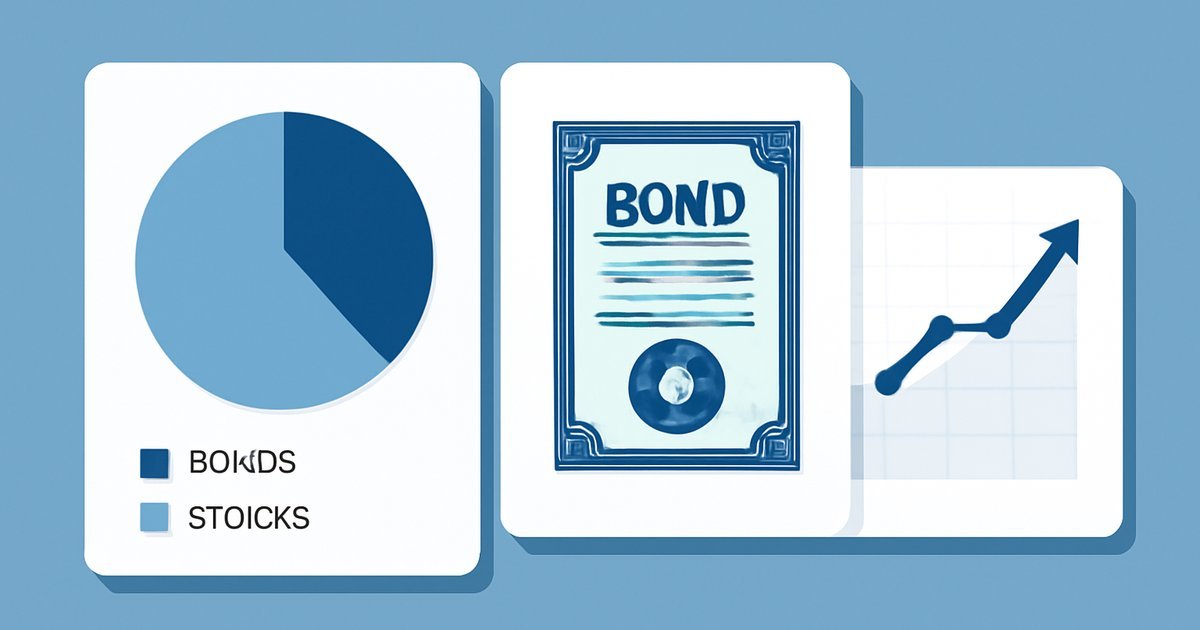
5. Diversification that actually works. Bonds often move independently of — or opposite to — stocks, providing genuine diversification. A classic 60/40 portfolio (60% stocks, 40% bonds) has historically delivered strong risk-adjusted returns over long time horizons.
Types of Bonds Available to US Investors
Not all bonds are created equal. Understanding the main categories helps you match the right bond type to your financial goals.
US Treasury Securities — Issued by the federal government and backed by the full faith and credit of the United States. These are the safest bonds in the world. They come in several forms:
- Treasury Bills (T-Bills): Mature in 4 weeks to 1 year
- Treasury Notes (T-Notes): Mature in 2 to 10 years
- Treasury Bonds (T-Bonds): Mature in 20 to 30 years
- TIPS (Treasury Inflation-Protected Securities): Principal adjusts with inflation, protecting purchasing power
- I Bonds: Inflation-linked savings bonds with a current composite rate that adjusts every 6 months
Municipal Bonds (Munis) — Issued by states, cities, and local governments to fund public projects. Interest is typically exempt from federal income tax. Best suited for investors in higher tax brackets.
Corporate Bonds — Issued by companies ranging from blue-chip firms (investment grade) to smaller, riskier businesses (high yield, also called “junk bonds”). They pay higher interest rates than Treasuries to compensate for additional risk.
Agency Bonds — Issued by government-sponsored enterprises like Fannie Mae or Freddie Mac. Slightly higher yields than Treasuries with similar safety profiles in most cases.
Bond Funds and ETFs — Instead of buying individual bonds, you can invest in a fund that holds hundreds or thousands of bonds. This provides instant diversification and is often the best starting point for beginners. For more on this approach, see our guide on income-generating investment vehicles.
How to Start Investing in Bonds: Step-by-Step
Getting started with bonds is more straightforward than most people think. Here’s a clear, actionable path:
- Define your goal and timeline. Are you investing for income, capital preservation, or diversification? Your goal determines which bond type fits. Short timeline (1–3 years)? Consider T-Bills or short-term bond funds. Long-term wealth building? A mix of intermediate and long-term bonds may work better.
- Assess your tax situation. If you’re in the 24% federal tax bracket or higher, municipal bonds may offer better after-tax returns than comparable taxable bonds. A CPA can help you run the numbers. Generally speaking, hold taxable bonds in tax-advantaged accounts (IRA, 401k) and munis in taxable brokerage accounts.
-
Choose your investment vehicle.
- TreasuryDirect.gov: Buy US Treasury bonds, notes, bills, TIPS, and I Bonds directly from the government with no fees. Minimum purchase is $100.
- Brokerage account: Buy individual bonds or bond ETFs through platforms like Fidelity, Vanguard, or Charles Schwab. Bond ETFs like BND (Vanguard Total Bond Market ETF) or AGG (iShares Core US Aggregate Bond ETF) are excellent starter options.
- Retirement accounts: Adding bond funds to your 401(k) or IRA is often the simplest approach. If you recently rolled over a 401(k), check out our 401(k) to IRA rollover guide for investment allocation tips.
- Decide between individual bonds and bond funds. Individual bonds give you fixed income and a guaranteed return of principal at maturity. Bond funds offer diversification and liquidity but fluctuate in price daily. Most beginners are better served starting with bond funds or ETFs.
- Determine your allocation. A commonly used rule of thumb is to subtract your age from 110 — the result is the percentage you might allocate to stocks, with the remainder in bonds. A 50-year-old might consider a 60% stock / 40% bond split. However, your actual allocation should reflect your risk tolerance, income needs, and retirement timeline.
- Ladder your bond purchases (advanced strategy). Bond laddering means buying bonds with staggered maturity dates — say, 2, 4, 6, 8, and 10 years. As each bond matures, you reinvest the proceeds. This reduces interest rate risk and ensures regular access to cash.
Costs, Fees, and Risks You Must Understand
In 2022, the Bloomberg US Aggregate Bond Index dropped nearly 13% — its worst year on record — as the Federal Reserve aggressively hiked interest rates. Many investors were shocked. That’s why understanding bond risks is non-negotiable.
Interest rate risk: This is the biggest risk for bond investors. When the Fed raises rates, existing bond prices fall because new bonds offer better yields. Long-term bonds are far more sensitive to rate changes than short-term ones. A 30-year Treasury can lose 15–20% of its market value when rates rise 1–2%.
Credit (default) risk: If the issuer fails to make interest payments or can’t repay principal, you could lose money. US Treasuries have essentially zero default risk. Investment-grade corporate bonds carry moderate risk. High-yield (junk) bonds carry significant default risk — sometimes 5–10% annual default rates during recessions.
Inflation risk: If inflation runs at 4% and your bond yields 3%, you’re losing purchasing power in real terms. TIPS and I Bonds are specifically designed to address this risk.
Liquidity risk: Some bonds, particularly municipal and corporate bonds, are thinly traded. Selling before maturity may mean accepting a lower price. Bond ETFs, by contrast, trade on exchanges all day like stocks — offering far better liquidity.
Call risk: Some bonds have a “call” provision allowing the issuer to repay the bond early — usually when rates fall and they can refinance cheaper. This cuts off your income stream at the worst possible time.
Fees to watch:
- Bond ETF expense ratios: typically 0.03%–0.25% annually. Vanguard and iShares offer very low-cost options.
- Broker markups on individual bonds: When buying corporate or municipal bonds through a broker, a markup (spread) is built into the price — often 0.5%–2%. Always compare prices across brokers.
- No-transaction-fee (NTF) funds: Available at most major brokers — a good way to avoid trading commissions.
Common Mistakes to Avoid When Investing in Bonds
Mistake 1: Ignoring interest rate risk on long-term bonds. Many first-time bond investors buy 20- or 30-year bonds attracted by higher yields — then panic when prices drop 15% after a rate hike. If you might need the money in 5 years, don’t lock it up in a 30-year bond. Match your bond duration to your investment timeline.
Mistake 2: Holding bonds in the wrong account type. Holding tax-inefficient corporate bonds in a taxable brokerage account means paying ordinary income tax on every interest payment — which can eat up 22%–37% of your returns depending on your bracket. Keep taxable bonds in your IRA or 401(k). Municipal bonds, on the other hand, are generally best held in taxable accounts where their tax exemption provides the most benefit. For context on tax-advantaged accounts, review how a Roth IRA conversion might factor into your strategy.
Mistake 3: Chasing yield without checking credit ratings. A bond offering 10% when Treasuries yield 4.5% is a red flag, not a bargain. That extra yield is compensation for dramatically higher default risk. Always check the bond’s credit rating from Moody’s, S&P, or Fitch before investing. Investment grade is BBB- or higher. Below that is speculative (junk).
Mistake 4: Selling bond funds during temporary downturns. Bond fund prices fluctuate daily. Investors who sold bond funds in early 2022 locked in losses — those who held on saw partial recovery as markets stabilized. Unless your financial situation has fundamentally changed, avoid panic selling.
Mistake 5: Forgetting about inflation. A 3% yield sounds safe until inflation hits 5%. In real terms, you’re losing money every year. Always consider real (inflation-adjusted) returns, not just nominal yields. TIPS or I Bonds are worth considering as an inflation hedge within your bond allocation.
Alternatives to Consider
Bonds aren’t the only way to add stability and income to your portfolio. Depending on your situation, these alternatives may deserve a look:
High-Yield Savings Accounts and CDs
For very short-term capital preservation (under 2 years), high-yield savings accounts and certificates of deposit (CDs) are competitive options. As of early 2026, many online banks offer savings rates above 4.5%, with FDIC protection up to $250,000. There’s no market risk — your principal is guaranteed. The tradeoff is lower long-term returns and no price appreciation potential.
Dividend-Paying Stocks
If you’re looking for income with more growth potential, dividend stocks can complement or partially replace bonds. However, dividend stocks are still equities — they carry full market risk and can cut dividends during downturns. They’re generally not a substitute for bonds in a risk-management context.
Annuities (Fixed or Fixed-Indexed)
For retirees seeking guaranteed income, fixed annuities function somewhat like bonds — you give an insurance company a lump sum in exchange for regular payments. They can provide income certainty but come with complexity, high surrender charges, and are not FDIC insured. Always scrutinize the fine print and consult a fee-only financial advisor before purchasing any annuity.
Frequently Asked Questions About Bond Investing
Q: How much of my portfolio should be in bonds?
A: There’s no universal answer, but a general starting point is subtracting your age from 110 to get your stock allocation, with the rest in bonds. A 45-year-old might consider 65% stocks and 35% bonds. That said, your risk tolerance, income needs, and retirement timeline matter more than any formula. A fee-only financial advisor can help you determine the right mix.
Q: Are bonds safe if the government defaults?
A: US Treasury bonds are considered the safest investment in the world because the US government can always print dollars to repay its debt. A technical default on US debt is considered an extreme tail risk. If it happened, virtually no investment would be safe — so Treasuries remain the closest thing to risk-free in practical investing.
Q: What’s the minimum investment to start buying bonds?
A: Through TreasuryDirect.gov, you can buy I Bonds and Treasuries for as little as $100. Bond ETFs can be purchased for the price of a single share — often $75–$110 — and some brokers offer fractional shares. There’s no meaningful financial barrier to getting started.
Q: Are bond interest payments taxed?
A: Generally, yes. Interest from corporate and Treasury bonds is taxed as ordinary income at your federal rate. Treasury interest is exempt from state and local taxes. Municipal bond interest is usually exempt from federal taxes and often state taxes. TIPS interest and inflation adjustments are taxable in the year they occur, which is why TIPS are best held in tax-advantaged accounts.
Q: Should I buy individual bonds or bond ETFs?
A: For most investors, bond ETFs are the better starting point. They provide instant diversification, low costs, and daily liquidity. Individual bonds make more sense for investors who want a specific maturity date, a guaranteed return of principal, or are building a bond ladder. In most cases, a low-cost total bond market ETF like Vanguard’s BND is an excellent core holding.
Conclusion: Build Stability Into Your Financial Future
Bonds aren’t glamorous — they don’t go viral on social media or generate FOMO the way hot stocks do. But that’s precisely why they work. Over decades of market cycles, bonds have consistently served their core purpose: reducing volatility, generating reliable income, and preserving capital when it matters most.
Whether you’re in your 30s and want to smooth out your portfolio’s ride, or in your 60s protecting decades of savings, bonds deserve serious consideration. Start with a low-cost bond ETF in your retirement account, understand the interest rate environment, and build from there.
Your next step: log into your brokerage or 401(k) account this week and review your current bond allocation. If it’s zero — or significantly below your age-appropriate target — it may be time to rebalance.
This article is for educational purposes only and does not constitute financial, tax, or investment advice. Always consult a licensed financial advisor, CPA, or attorney before making financial decisions.