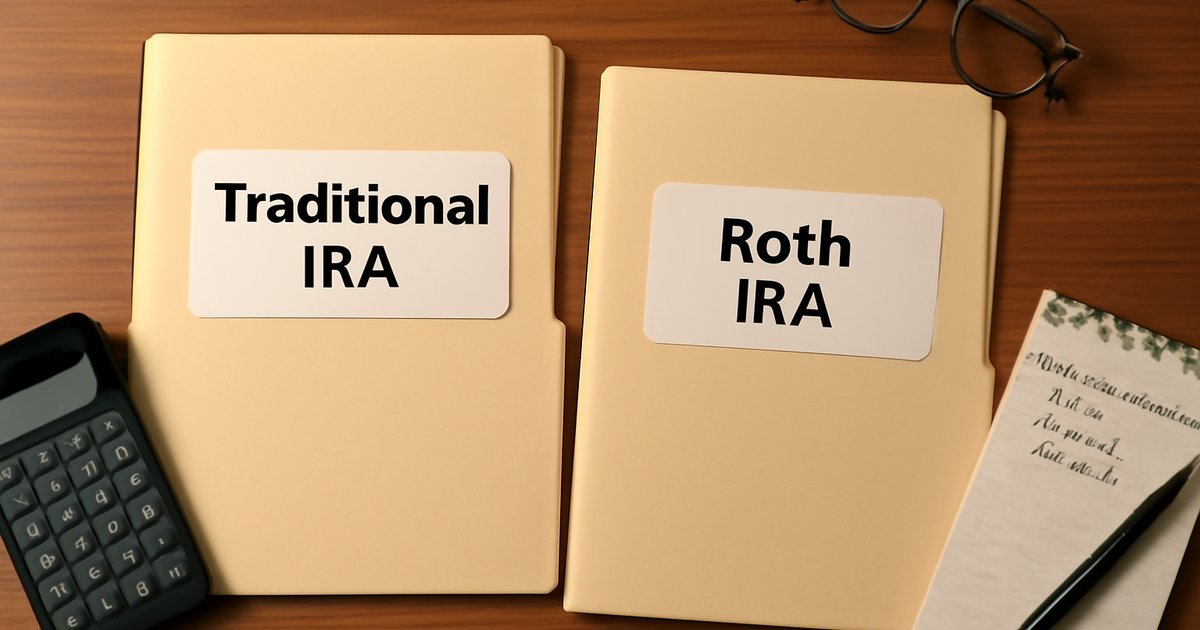
Two Accounts, One Big Decision
Choosing the wrong IRA could cost you tens of thousands of dollars in retirement — here’s how to pick the right one.
According to the Investment Company Institute, Americans held over $13.9 trillion in Individual Retirement Accounts as of 2024 — yet a surprising number of savers still aren’t sure which type of IRA they actually have, or whether it’s the best fit for their situation.
If you’ve ever typed "Traditional IRA vs Roth IRA" into a search bar and walked away more confused than before, you’re not alone. Both accounts help you save for retirement. Both offer significant tax advantages. But the differences between them — especially around when you get taxed — can have a dramatic impact on how much money you actually keep in retirement.
In this guide, you’ll learn exactly how each account works, who benefits most from each, how contribution limits and income rules apply in 2026, and the key mistakes people make when choosing between them. By the end, you’ll have a clear framework for making this decision with confidence.
This article is for educational purposes only and does not constitute financial, tax, or investment advice. Always consult a licensed financial advisor, CPA, or attorney before making financial decisions.
What Is a Traditional IRA and How Does It Work?
A Traditional IRA (Individual Retirement Account) is a tax-advantaged savings account that lets you contribute pre-tax or after-tax dollars — and defer taxes on your investment growth until you withdraw the money in retirement.
Here’s the core mechanic: if you qualify for a deductible contribution, the money you put in reduces your taxable income today. For example, if you earn $80,000 and contribute $7,000 to a Traditional IRA, your taxable income drops to $73,000 for that year. You pay taxes on the money — plus any growth — only when you take distributions later.
According to the IRS, the 2026 contribution limit for both Traditional and Roth IRAs is $7,000 per year, with a $1,000 catch-up contribution allowed if you’re age 50 or older — bringing the maximum to $8,000.
The deductibility of your Traditional IRA contributions depends on whether you (or your spouse) have access to a workplace retirement plan like a 401(k) and what your income is. If neither of you has a workplace plan, your contributions are fully deductible regardless of income.
Once you reach age 73, you are required to take distributions — known as Required Minimum Distributions, or RMDs — whether you need the money or not. This is a key distinction that separates Traditional IRAs from Roth IRAs.
What Is a Roth IRA and How Is It Different?
A Roth IRA flips the tax equation. You contribute after-tax dollars — meaning you don’t get a tax deduction today — but your money grows completely tax-free, and qualified withdrawals in retirement are also 100% tax-free.
That’s a powerful long-term advantage. Imagine contributing $7,000 per year for 25 years and watching it grow to $400,000 or more. With a Roth IRA, every dollar of that growth could be withdrawn in retirement without owing a cent in federal income tax.
Roth IRAs also have no RMDs during the original owner’s lifetime, giving you more flexibility in how and when you tap your savings. This makes them particularly valuable for estate planning and for people who expect to have other income sources in retirement.
However, Roth IRAs come with income eligibility limits. For 2026, you can contribute the full amount if your Modified Adjusted Gross Income (MAGI) is under $146,000 (single filers) or $230,000 (married filing jointly). Contributions phase out above those thresholds and are eliminated entirely at $161,000 (single) and $240,000 (married), based on IRS 2026 guidelines.
If your income is too high for a direct Roth IRA contribution, you may have heard of the "backdoor Roth IRA" strategy — a legal method of contributing through a non-deductible Traditional IRA and converting it. That’s worth exploring with a financial advisor if you’re in that income range.
Key Benefits of Each Account
Traditional IRA Advantages
- Immediate tax break: Deductible contributions lower your taxable income the year you contribute — a real advantage if you’re in a higher tax bracket now.
- No income limit for contributions: Anyone with earned income can contribute to a Traditional IRA (though deductibility has income limits).
- Tax-deferred growth: Dividends, interest, and capital gains aren’t taxed while they sit in the account — your money compounds faster.
Roth IRA Advantages
- Tax-free retirement income: Withdrawals in retirement don’t count as taxable income — critical if you expect to be in a higher bracket later.
- No RMDs: You’re never forced to take withdrawals, giving you maximum flexibility.
- Contribution withdrawal flexibility: You can withdraw your original contributions (not earnings) at any time, penalty-free — making it a somewhat flexible account in a pinch.
- Estate planning benefits: Inherited Roth IRAs still pass income-tax-free to beneficiaries (though new rules under the SECURE 2.0 Act apply).
How to Choose: A Step-by-Step Decision Framework
Choosing between a Traditional and Roth IRA isn’t one-size-fits-all. Use this framework to guide your thinking:
- Compare your current tax bracket to your expected retirement tax bracket. If you’re in the 22% or higher bracket now and expect to drop significantly in retirement, the Traditional IRA’s upfront deduction may serve you better. If you’re in a lower bracket now (say 12% or 15%) and expect income to rise, the Roth IRA’s future tax-free withdrawals become more valuable.
- Check your income eligibility. If your MAGI exceeds Roth IRA limits, you’ll need a backdoor Roth or must use a Traditional IRA. Visit IRS.gov or consult a CPA to confirm your exact phase-out range.
- Consider your timeline. Generally speaking, the longer your money has to grow tax-free in a Roth IRA, the more powerful the benefit. A 35-year-old has far more to gain from a Roth than someone starting at 60.
- Think about RMDs. If you’ll have significant income in retirement from Social Security, pensions, or rental property, forced withdrawals from a Traditional IRA could push you into a higher bracket. A Roth IRA avoids this problem.
- Factor in estate goals. If you want to leave retirement assets to heirs, a Roth IRA — with no RMDs and tax-free inheritance (up to 10-year distribution rules) — is generally the more estate-friendly option.
- Consider splitting contributions. Many financial advisors suggest diversifying your tax exposure by contributing to both a Traditional and Roth account over time. This gives you flexibility to manage your tax bracket in retirement by choosing which account to draw from.
If you’re also self-employed and looking at other retirement vehicles, our guide on SEP IRA: The Self-Employed Retirement Plan That Saves Big covers a powerful alternative worth considering alongside your IRA strategy.
Costs, Fees, and Risks to Understand
IRAs themselves don’t charge fees — but the financial institution or brokerage where you open yours might. Here’s what to watch for:
- Account maintenance fees: Some brokerages charge $15–$50 annually. Look for providers like Fidelity, Vanguard, or Schwab that offer no-fee IRA accounts.
- Expense ratios on investments: The mutual funds or ETFs you hold inside your IRA have their own annual costs. According to Morningstar, the average expense ratio on actively managed funds is around 0.60%–1.00%, while index funds often charge under 0.10%. Over decades, this gap is enormous.
- Early withdrawal penalties: If you withdraw earnings from either type of IRA before age 59½ without a qualifying exception, you’ll owe a 10% penalty plus income taxes. Roth IRA contributions (not earnings) can be withdrawn early without penalty.
- Excess contribution penalties: Contributing more than the annual limit results in a 6% excise tax per year on the excess amount until corrected. Track your contributions carefully.
- Tax risk in Traditional IRAs: The future is uncertain. If tax rates rise significantly by the time you retire, you could end up owing more than you saved with the upfront deduction.
Common Mistakes to Avoid
These are the errors that consistently cost people money — often without them realizing it until it’s too late.
1. Choosing based only on today’s tax situation. Many people default to a Traditional IRA because the immediate deduction feels good. But if you’re in your 30s or 40s and your income will likely rise, locking in tax-free growth with a Roth IRA could be far more valuable over the long run.
2. Not contributing at all because "the decision feels complicated." Analysis paralysis is real — and expensive. Contributing $7,000 to the "wrong" IRA is almost always better than not contributing at all. You can adjust your strategy each year.
3. Overlooking the Roth IRA income limits. High earners sometimes contribute directly to a Roth IRA without realizing they’re ineligible. This triggers excess contribution penalties. Always verify your MAGI before contributing.
4. Withdrawing earnings early from a Roth IRA. People sometimes confuse "contributions can be withdrawn freely" with "everything can be withdrawn freely." The earnings portion is subject to taxes and penalties if withdrawn before 59½ and before the account has been open at least five years.
5. Forgetting about spousal IRA contributions. If one spouse doesn’t have earned income, a working spouse can still fund a "spousal IRA" — either Traditional or Roth — allowing a household to contribute up to $14,000–$16,000 annually depending on age. Many couples leave this opportunity on the table.
For anyone building a comprehensive retirement strategy, it also pays to understand investment options inside your IRA. Our Index Fund Investing: A Beginner’s Complete Guide is a great resource for choosing low-cost investments inside either account type.
Alternatives to Consider
An IRA isn’t your only option. Depending on your employment status and goals, these alternatives may be worth comparing:
401(k) or 403(b) through an employer: These accounts have much higher contribution limits — $23,500 in 2026, or $31,000 for those 50 and older. If your employer offers a match, this should generally come first before you contribute to an IRA. Many 401(k) plans also now offer a Roth option.
SEP IRA or Solo 401(k) for self-employed individuals: If you run your own business, a SEP IRA allows contributions of up to 25% of net self-employment income, up to $70,000 in 2026. This dwarfs the standard IRA limit and can dramatically accelerate retirement savings.
Health Savings Account (HSA): Often called a "triple-tax-advantaged" account, an HSA lets you contribute pre-tax, grow tax-free, and withdraw tax-free for qualified medical expenses — and after age 65, you can withdraw for any purpose (paying ordinary income tax, like a Traditional IRA). This makes it a stealth retirement vehicle worth maxing out if you’re eligible.
Frequently Asked Questions
Can I have both a Traditional IRA and a Roth IRA at the same time?
Yes — but your total contributions across both accounts combined cannot exceed the annual limit ($7,000 in 2026, or $8,000 if you’re 50+). You can split the amount however you like between the two accounts.
What happens if I contribute to a Roth IRA but my income is over the limit?
You’ll owe a 6% excess contribution penalty for each year the money remains in the account. You can fix this by withdrawing the excess before the tax filing deadline, or by using the backdoor Roth IRA strategy with proper documentation. Consult a CPA if you’re near the income thresholds.
Does it make sense to convert a Traditional IRA to a Roth IRA?
In many cases, yes — especially if you’re in a low-income year, recently retired, or expect tax rates to rise. Conversions are taxable in the year you convert, so timing matters significantly. A CPA can help model the optimal conversion amount based on your situation.
At what age must I start taking money out of a Traditional IRA?
Under current IRS rules (updated by the SECURE 2.0 Act), you must begin taking Required Minimum Distributions from a Traditional IRA by April 1 of the year after you turn 73. Roth IRAs have no RMDs during the original owner’s lifetime.
Can I still contribute to an IRA if I have a 401(k) at work?
Yes — having a 401(k) doesn’t prevent you from contributing to an IRA. However, it may affect whether your Traditional IRA contribution is tax-deductible. Income limits apply for deductibility when you’re covered by a workplace plan. Roth IRA eligibility is based solely on your MAGI, not your employer plan status.
Final Thoughts: Make the Decision and Start
The Traditional IRA vs. Roth IRA debate doesn’t have one universal right answer. The best account for you depends on your current income, your expected tax situation in retirement, your timeline, and your broader financial goals.
As a general rule: if you expect to be in a higher tax bracket in retirement than you are today, the Roth IRA is usually the stronger choice. If you’re in a high bracket now and expect to drop significantly later, the Traditional IRA’s upfront deduction may serve you better. And if you’re unsure — which is completely reasonable — splitting contributions between both is a practical hedge.
The most important step is to open an account and start contributing. Time in the market, not timing the market, is what builds long-term retirement wealth. Don’t let the decision slow you down. You can always adjust your approach as your income and tax situation evolve. And for deeper planning, consider connecting with a Medicare for Retirees or retirement income advisor who can build a personalized roadmap.
Your next action: Check your MAGI against the 2026 Roth IRA income limits. If you qualify, open or contribute to a Roth IRA before the April tax deadline. If you’re unsure which option fits your situation, schedule a session with a licensed financial advisor or CPA before the year ends.
Financial Disclaimer: This article is for educational purposes only and does not constitute financial, tax, or investment advice. Always consult a licensed financial advisor, CPA, or attorney before making financial decisions.